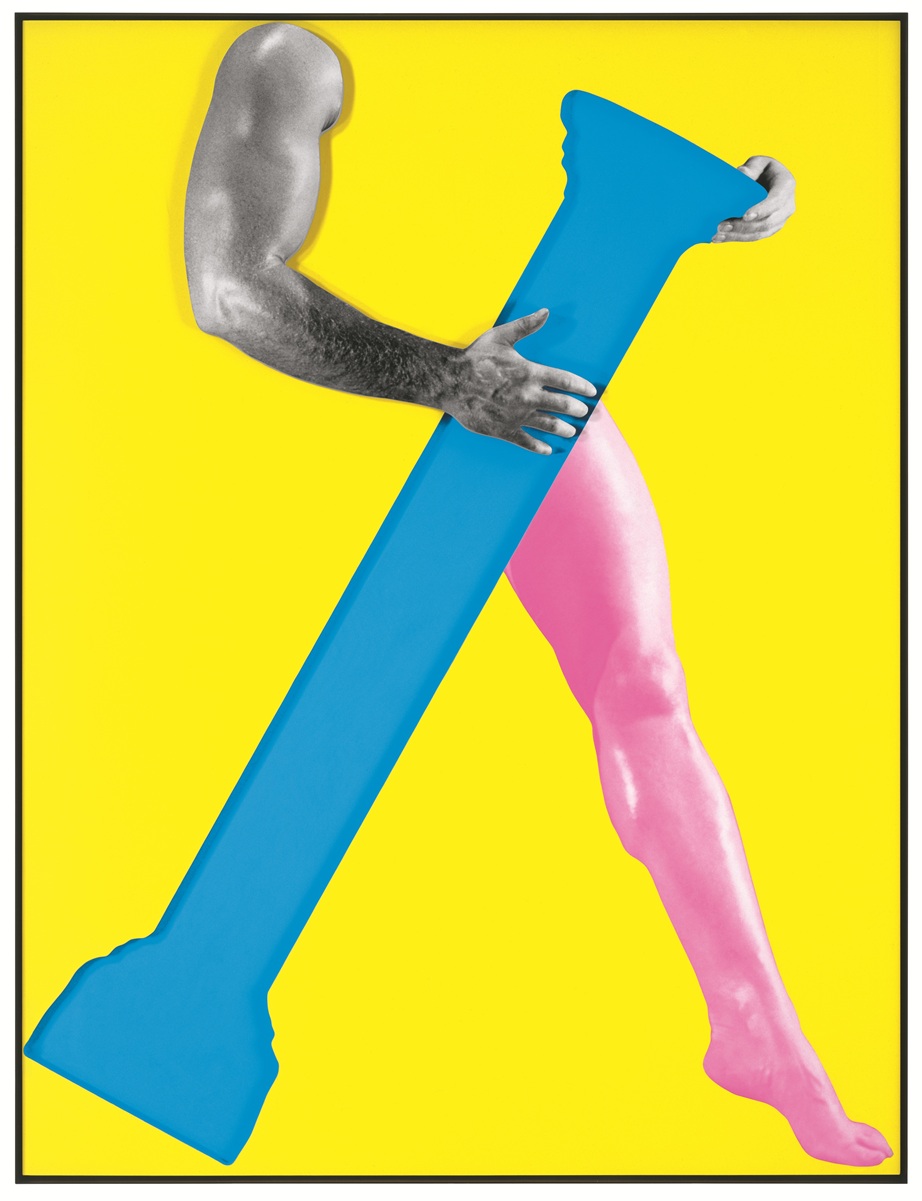
The Centre for Fine Arts (Bozar) in Brussels is a fascinating space. Its programme is very dynamic and sophisticated. Currently it presents, John Baldessari: Parables, Fables, and Other Tall Tales, the first major European exhibition devoted to the American artist since his death in 2020. On view until 1 February 2026, the exhibition offers a focused reassessment of a figure central to the development of late 20th-century Conceptual art.
Rather than adopting a chronological structure, the exhibition concentrates on Baldessari’s mature practice from the 1980s onwards, situating it within the conceptual strategies he developed from the 1960s. The presentation showcases the artist’s continuous engagement with narrative disruption, visual interruption and the instability of meaning, key concerns that reappear throughout his work across media.
Born in National City, California, in 1931, Baldessari was a pioneering figure in American Conceptual art. Based in Los Angeles, he exerted a formative influence on several generations of artists, including David Salle, Cindy Sherman and Barbara Kruger. His practice consistently challenged traditional notions of authorship, medium and interpretation, expanding the parameters of what art could be.
A decisive moment in Baldessari’s career was The Cremation Project (1970), in which he ceremonially burned all the paintings he had made between 1953 and 1966, marking a definitive rejection of the painted image. Other canonical works include I Will Not Make Any More Boring Art (1971), a performance and video that turns repetition into critique, and Baldessari Sings LeWitt (1972), in which the artist sings Sol LeWitt’s Sentences on Conceptual Art. These works exemplify Baldessari’s use of humour to interrogate and undermine conceptual orthodoxies.
The exhibition features film stills obscured by coloured dots, text-based works that replace images entirely, and serial compositions that expose how meaning is constructed. Baldessari frequently cited influences ranging from Claude Lévi-Strauss’s structuralism to the French New Wave, particularly the films of Jean-Luc Godard.
His work has also been discussed in relation to European Conceptualism and Surrealism, notably the legacies of René Magritte and Marcel Broodthaers, whose use of language, irony and institutional critique resonates strongly with his approach. Perfect for Brussels! Magritte’s Ceci n’est pas une pipe finds a clear echo in a work on view featuring an image of a painting by Salvador Dalí with the name “Duchamp” written beneath it, a gesture that similarly destabilises representation and the trust placed in images. Who is concerned about fake news these days?
He famously said: “I like to have a lot of books and magazines around that I can pick up and read. That’s sort of my surrogate world, along with TV. I think that comes from growing up in a ghetto where there weren’t any books or any rich life. I had to send away for books and magazines; I sort of imported my culture for myself.
Both my parents were European immigrants … and there was no common language. I probably have more regard for language than I do for art specifically because I read more about language and writing than I do about art.”
The exhibition presents a non-chronological, immersive selection of John Baldessari’s work from 1966 to 2017, focusing on key moments rather than offering an exhaustive survey. Conceived in keeping with Baldessari’s identity as a storyteller, the show emphasises experience over linear history and reflects his use of art as a means of conveying ideas and knowledge. After abandoning painting in the mid-1960s, Baldessari primarily worked with photography and, in the 1970s, expanded into 16 mm film, a medium closely tied to Los Angeles’s film and media industries.
Brussels played an important role in Baldessari’s early European reception. He held several solo exhibitions in the city in the 1970s and was later represented for decades by Galerie Greta Meert. Bozar itself presented John Baldessari: Recent Works in 1988, making the current exhibition a significant return.
Fun fact: John Baldessari made a cameo appearance in a 2018 episode of The Simpsons, encountering Marge Simpson in a gallery of his own nose-themed works. The artist voiced two lines himself, a self-referential moment that reflects his embrace of humour, popular culture and the permeability between art and mass media. More to discover in this important exhibition.
–
 ART IS ALIVE