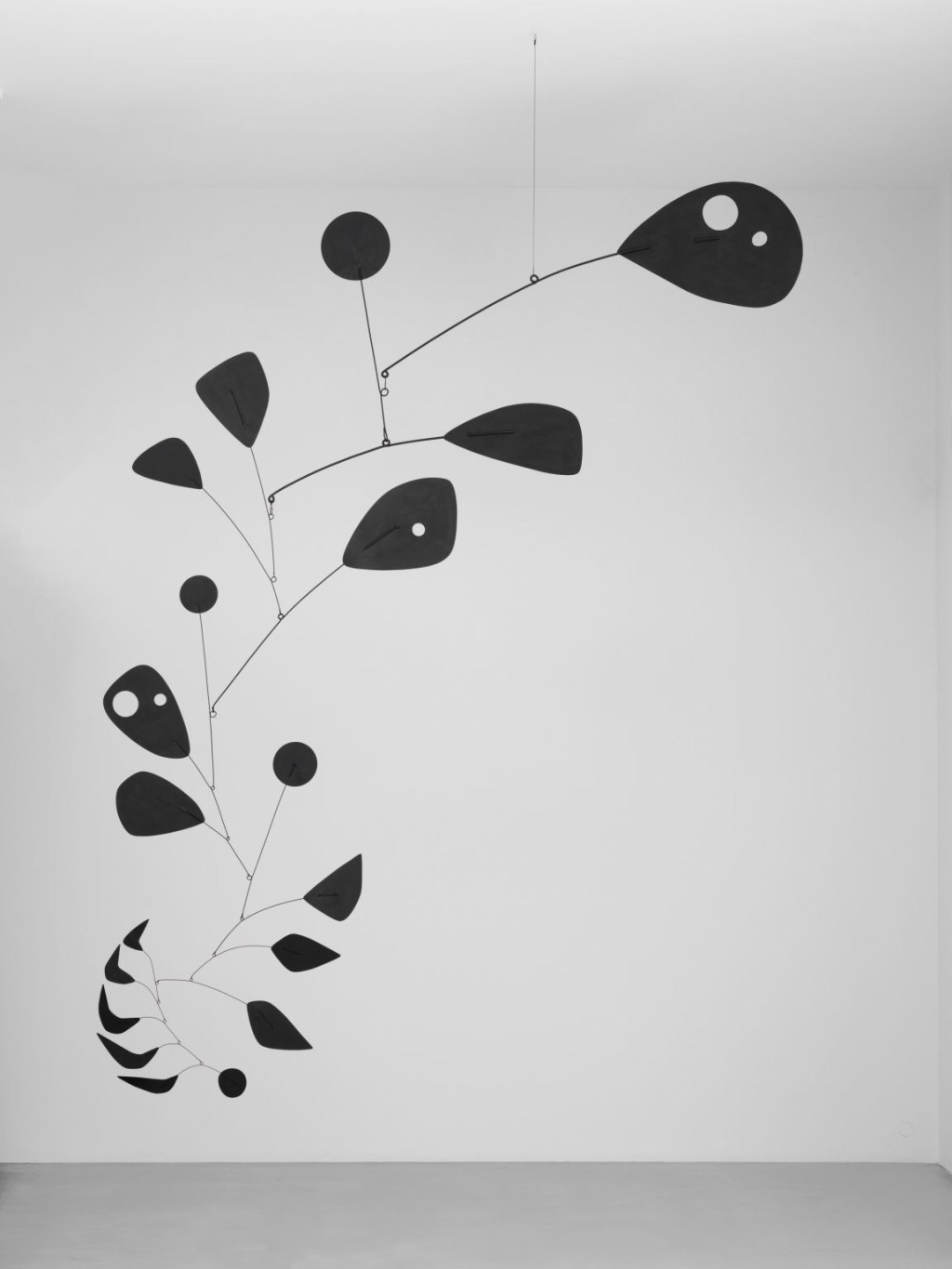
From April 15 to August 16, 2026, the Fondation Louis Vuitton will present one of the most ambitious retrospectives ever devoted to Alexander Calder (1898–1976).
Calder. Rêver en Équilibre marks two anniversaries: the centenary of the artist’s arrival in Paris in 1926, and fifty years since his death. Spanning more than five decades, the exhibition traces Calder’s journey from the early Cirque Calder performances, which enthralled the Parisian avant-garde, to the monumental public sculptures of the 1960s and 1970s that reshaped the very language of sculpture. Suspended in Frank Gehry’s fluid architecture, his mobiles animate the galleries, turning the Fondation itself into a kinetic stage.
Conceived with the Calder Foundation, the show will bring together nearly 300 works from leading international institutions and private collections. Mobiles and stabiles, Calder’s own terms for kinetic and static abstraction, sit alongside wire portraits, carved wooden figures, paintings, drawings, and sculptural jewellery. Spread across 3,000 sq. m, the exhibition highlights Calder’s enduring preoccupations: movement, light, reflection, sound, gravity, humble materials, and the ephemeral.
The retrospective will also place Calder within his vibrant network of contemporaries. Works by Jean Arp, Barbara Hepworth, Piet Mondrian, Paul Klee, and Pablo Picasso will underscore the dialogues that shaped his radical practice.
Thirty-four photographs by Henri Cartier-Bresson, André Kertész, Gordon Parks, Man Ray, Irving Penn, and Agnès Varda will offer intimate glimpses of an artist constantly negotiating art and life. Key series, including the Constellations and Calder’s playful jewellery, will reveal his inventiveness at every scale.
Born into a family of artists, Calder began with painting and drawing before studying at the Art Students League in New York. In 1926, he moved to Montparnasse, the epicentre of international art, quickly making a name with his wire sculptures and miniature circus. On loan from the Whitney Museum of American Art, the first time in 15 years, the Cirque Calder returns to Paris, recreating the tiny acrobats, clowns, and equestrians that once performed for Léger, Hélion, Le Corbusier, Arp, Miró, and Mondrian.
A pivotal visit to Mondrian’s studio in 1930 steered Calder toward abstraction. Duchamp coined the term “mobile” in 1931 for his kinetic constructions, first shown in Paris in 1932. Initially motorised, later set in motion by air currents, they drew, in Sartre’s words, “their life from the indistinct life of the atmosphere.” Arp’s term “stabile” described Calder’s static works, the other strand of his practice.
Although Calder returned to the U.S. in 1933, Europe remained central. He participated in the Spanish Republic Pavilion at the 1937 Paris World’s Fair and established a studio in Saché after the war.
Working across continents until his death in 1976, Calder redefined sculpture: from delicate metal assemblages responsive to the faintest breath of air to monumental public constructions, he created forms in constant dialogue with nature. As guest curators Dieter Buchhart and Anna Karina Hofbauer note, “Calder’s innovative approach expanded the dimensions of sculpture to include time as an essential fourth dimension. This promises to be one of the most important exhibitions of 2026!
–
Image: ALEXANDER CALDER, Black Widow, 1948 Sheet metal, wire and paint 325,1 x 251, 5 cm Instituto de Arquitetos do Brasil – Departamento de São Paulo © 2025 Calder Foundation, New York / ADAGP, Paris
 ART IS ALIVE