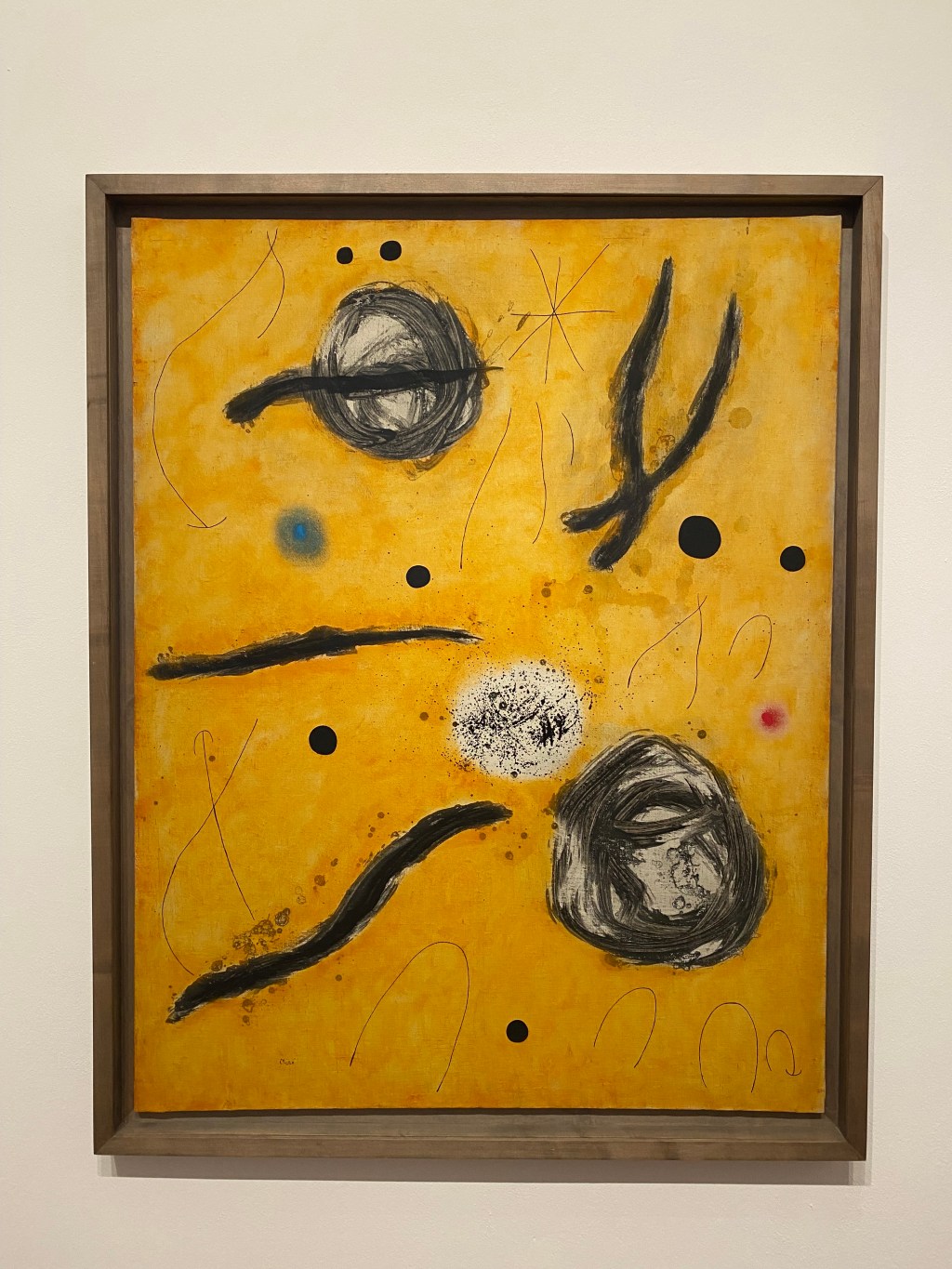
The fantastic Fundació Joan Miró in Barcelona, currently features Miró and the United States, a compelling re-examination of the Catalan master’s transatlantic encounters with artists and his public commissions in the US. This is one of the most significant exhibitions in Europe right now and it remains on view until 22nd February 2026.
Miró was struck by the “energy and vitality” of the American art scene. As he pursued new directions in painting, mural painting and printmaking, his interest in sculpture also intensified. Reciprocally, his international stature was shaped to a remarkable degree by the enthusiasm his work generated among artists in the United States, beginning in the 1920s and continuing for more than half a century. Over six subsequent visits, Miró’s exchanges with American artists proved instrumental in sustaining his capacity for reinvention and in opening new directions in his practice.
Although initially divisive, Miró’s work was steadily championed through exhibitions organised by his dealer Pierre Matisse, which helped establish his reputation as a leading figure of the inter-war generation. Retrospectives at the Museum of Modern Art in 1941 and 1959, both of which toured nationally, provided American artists with a direct point of comparison. In 1944, Jackson Pollock described Miró, alongside Picasso, as “the two artists I admire most.” Twenty-five years later, Miró would acknowledge the correlative nature of this exchange, stating: “It was really American painting that inspired me.”
Organised in a broadly chronological sequence across fifteen galleries, Miró and the United States charts these transatlantic exchanges through a series of focused, medium-specific sections. The exhibition maps artistic conversations involving more than forty artists from different generations, with particular emphasis on the 1940s and 1950s, a period of heightened experimentation in New York and, for Miró, one marked by significant public commissions.
Seen together, the works underline a shared ambition among Miró and his American contemporaries to develop forms of expression that were personal in origin yet universal in scope. Curated by Marko Daniel, Matthew Gale, and Dolors Rodríguez Roig, in collaboration with Elsa Smithgall of The Phillips Collection, the exhibition traces the intricate dialogue between Joan Miró and a constellation of American artists, including Jackson Pollock, Mark Rothko, Lee Krasner, Helen Frankenthaler, Arshile Gorky, Louise Nevelson, and Alice Trumbull Mason, alongside the often-overlooked contributions of Louise Bourgeois and many other artists.
Spanning Miró’s two New York retrospectives in 1941 and 1959 and his seven visits to the United States between 1947 and 1968, the show centres on the influence of the US as a pivotal place in the artist’s evolving practice.
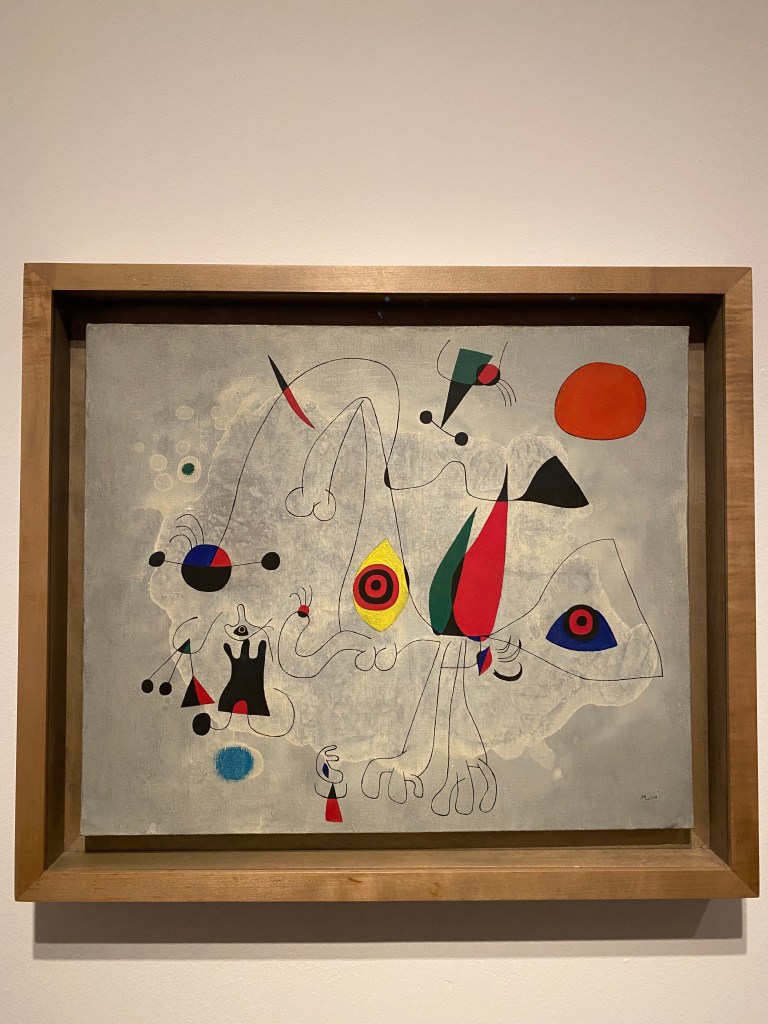
It opens with a spectacular room dedicated to Alexander Calder. Miró and Alexander Calder had been close friends ever since they met in Paris in 1928. ‘We’re like brothers,’ said Joan Miró. Calder made an ingenious wire portrait of Miró, after which they began to exchange works. In 1947, Miró arrived in the United States with his wife, Pilar Juncosa, and his daughter, Dolors Miró, and they were met at the airport by Calder and his wife, Louisa James. The exchanges continued during this period, with Calder swapping his piece Black Polygons (1947) for Miró’s Women and Bird in the Night (1947).
The two Catalan artists, Salvador Dalí and Joan Miró, had simultaneous retrospectives at the Museum of Modern Art (MoMA) in New York in 1941. The exhibition brings renewed focus to Miró’s Catalan milieu, where formative exchanges with fellow artists coincided with his emergence from Surrealism.
Miró’s Still Life with Old Shoe, 1937, on view in the exhibition, exerted a lasting influence on Arshile Gorky, most visibly in Garden in Sochi, 1951, where its forms are transformed into imagery drawn from Gorky’s childhood memories of a “Garden of Wish Fulfilment.” Gorky met Miró in 1947; the following year, he took his own life.
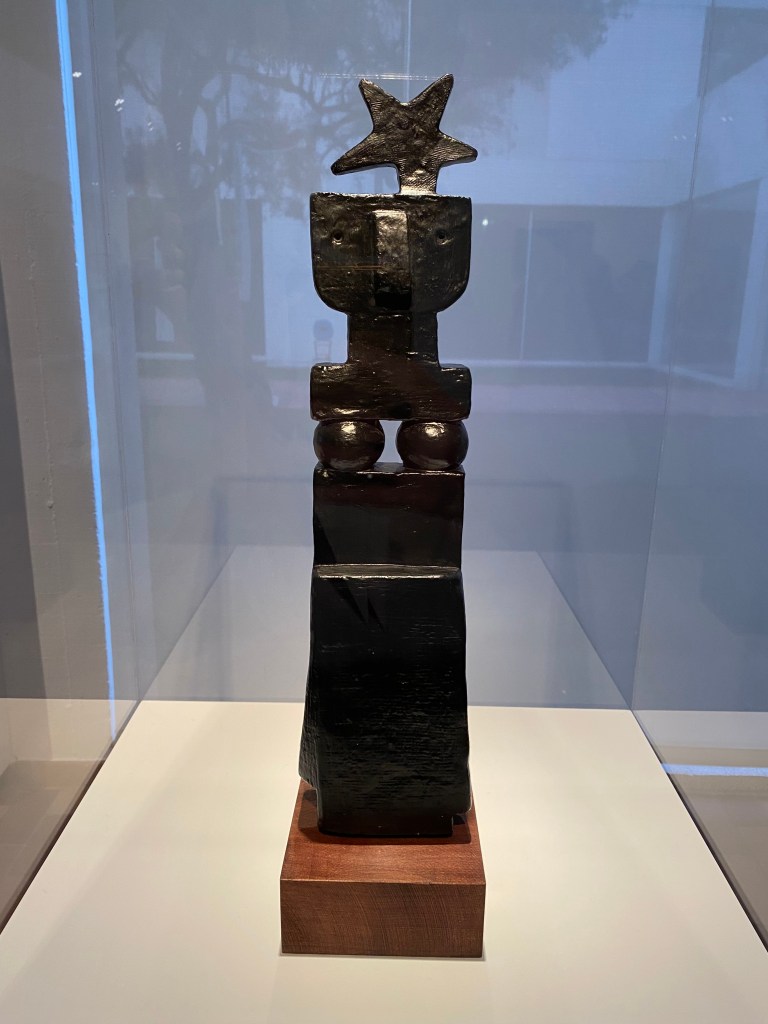
Louise Bourgeois’s Personnages marked a significant innovation in sculptural form, distilling human presence into upright, totemic figures. Bourgeois had known Miró in Paris, and their friendship deepened after his arrival in New York with his family in 1947. In acknowledgment of her assistance at Atelier 17, Miró presented her with a print.
Printmaking also connected Miró to a wider network of artists, including the sculptor Louise Nevelson. Her early sculptural works reveal figurative concerns shared with Miró, while her commitment to found materials anticipates a trajectory that would later resonate strongly with his own practice. Similarly, Herbert Ferber’s three-dimensional wall constructions captured a spatial and atmospheric sensibility responsive to Miró’s work. All three artists are also featured in the show.
A parallel concern with process and physical balance emerged in experimental films by Miró’s contemporaries. Among the most inventive, Maya Deren’s films distilled the bodily dynamism of the creative act, while Len Lye inscribed gesture directly onto celluloid, unfolding a choreography of movement across time.
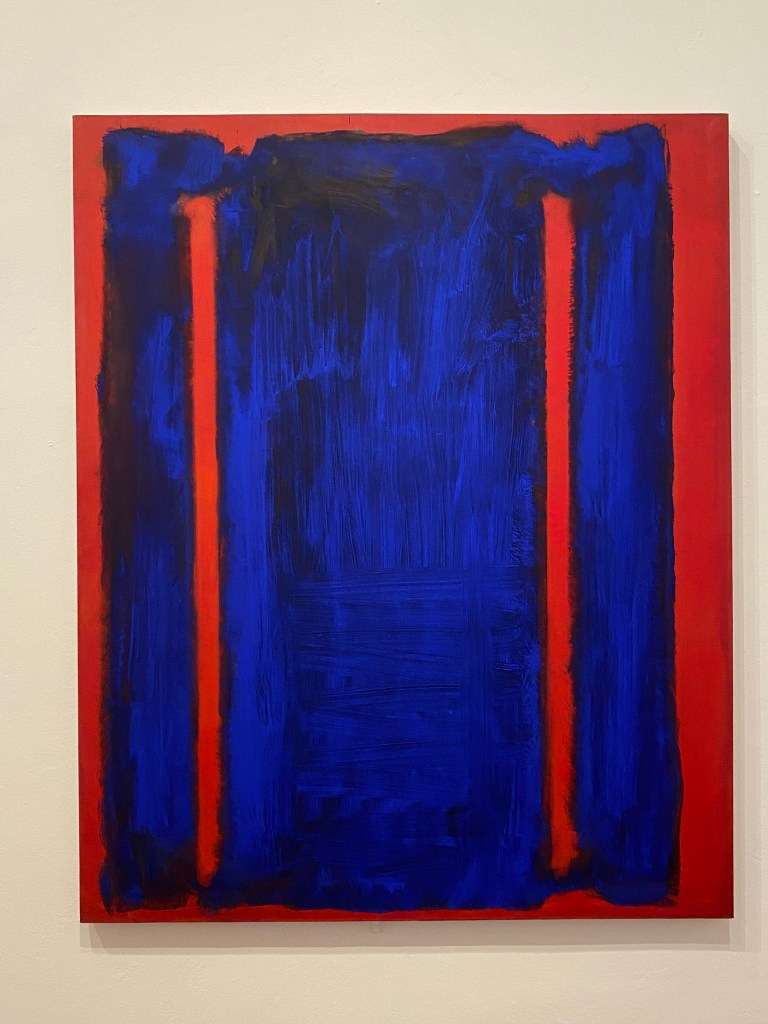
More highlights in this remarkable exhibition are the works of Mark Rothko when the show slowly moves to Abstract Expressionism. Rothko’s exposure to the work of Milton Avery, mediated through his close exchanges with Adolph Gottlieb and Barnett Newman, was instrumental in affirming the possibility of a sustained artistic career. His early commitment to urban realism gradually shifted towards imagery informed by myth and archetype. Untitled was reproduced in Possibilities (on view in the show), the journal edited by Robert Motherwell and published in late 1947, where Rothko characterised his paintings “as dramas: the shapes… are the performers.” These early biomorphic motifs would later resolve into the expansive colour fields of his mature practice; another implicit dialogue with Miró.
Central to the exhibition is a sustained attention to gender too. By exploring the contributions of female artists who were instrumental in shaping mid-20th-century abstraction, the show positions Miró within a broader, more inclusive artistic network. Lee Krasner and Jackson Pollock attended Miró’s 1941 retrospective and responded with particular enthusiasm to the Constellations series shown in 1945. As Krasner observed, “each painting is a little miracle,” a response that resonates in her Little Image paintings, which can be read as a dialogue with their formal and imaginative challenge.
More than 130 works drawn from European and American collections, alongside the Fundació’s own collection, illustrate the enrichment of European and American modernism as a whole. In doing so, the exhibition challenges the conventional Paris-centric narrative of Miró’s career, highlighting the crucial role of American abstraction (and women artists), action painting, and gestural experimentation in his own work. The show will subsequently travel to The Phillips Collection in Washington (21 March–5 July 2026) and is one to travel to Spain for!
–
 ART IS ALIVE