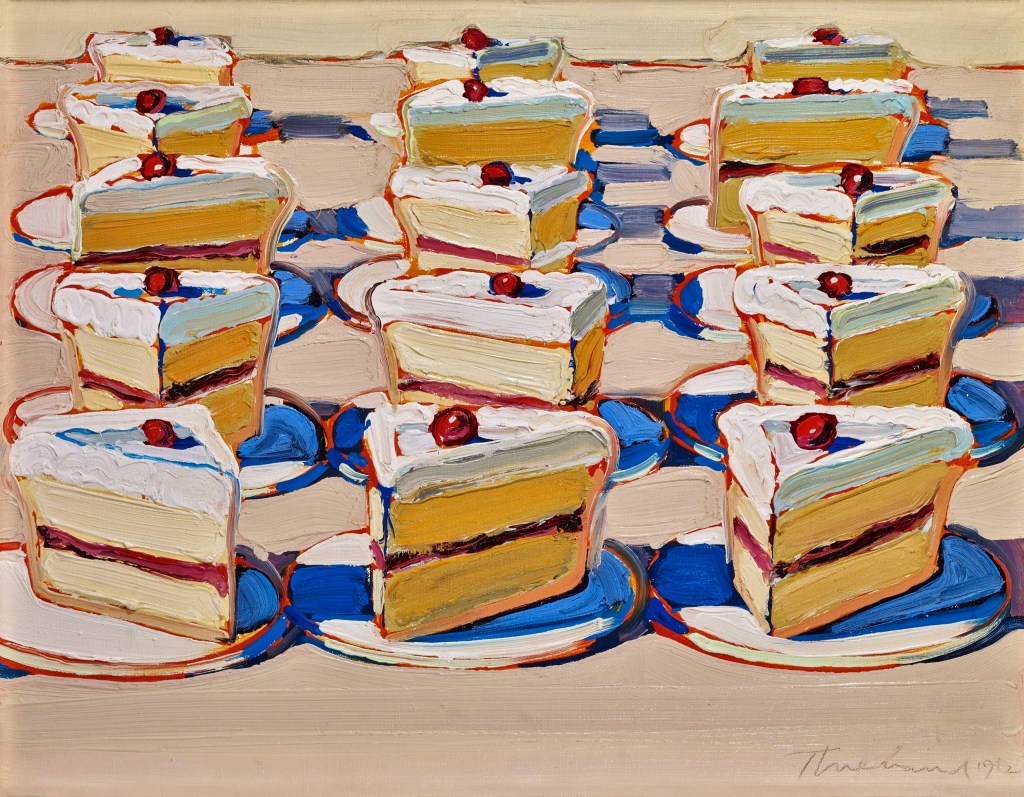
Wayne Thiebaud’s paintings have always fascinated audiences. The Courtauld’s exhibition, American Still-Life, running until 18th January 2026, is filled with his signature creamy pies, lollipops, ice creams and hot dogs. Seen together, these works become less about sweetness than about the opulence of the post–Second World War United States, and the illusions that excess quietly sustained.
At first glance, the subject matter reads as unabashedly indulgent. Pies sit on counters with thick cream; ice creams tilt precariously on cones; hot dogs line up (Pie Rows, 1961, Five Hot Dogs, 1961) with deadpan regularity. Thiebaud’s surfaces are luscious, his colours saturated, his paint applied with a tactile insistence that borders on the sculptural. They are isolated, frontal, often repeated, stripped of context or human presence. The promise of abundance becomes oddly impersonal, even melancholic.
This ambivalence speaks directly to the postwar moment from which the works emerged. Thiebaud captures a world newly intoxicated by consumer choice, mass production and leisure. The counters are too clean, the shadows too emphatic, the spaces too still. These brilliant staged settings give a sense of fragility.
The exhibition is especially resonant at the Courtauld, where Thiebaud’s work sits in close dialogue with art history. His fascination with Édouard Manet’s A Bar at the Folies-Bergère, displayed nearby in the permanent collection, offers a revealing point of comparison. Like Manet, Thiebaud was absorbed by the mechanics of display and desire: the way commodities are presented. The frontal counters in Thiebaud’s paintings echo the barmaid’s threshold space, where consumption is promised.
The show also firmly places Thiebaud within the artistic currents of the 1960s. His clarity of form and bold chromatic separations align him with contemporaries such as Kenneth Noland, Frank Stella and Ellsworth Kelly, as seen in Four Pinball Machines, 1962. These artists were similarly invested in colour as structure. Yet Thiebaud remains distinct. Where his peers often pursued abstraction, he stayed resolutely figurative, using everyday motifs as a means to explore formal edge and depth.
At the same time, the exhibition underscores his deep engagement with other masters, particularly Cezanne. Thiebaud’s thick outlines owe as much to modern art as to Pop. His thick layers of paint never merely descriptive; they build form, creates tension, and occupy space. The simplicity of the shapes, rows of circles and triangles, reminded him of Cezanne’s claim that authentic painting should be built from basic forms.
That this exhibition is staged at the Courtauld feels entirely fitting. Few UK institutions are better placed to frame Thiebaud as both a painter of his moment and an artist in sustained conversation with the history of painting. The works on paper displayed on the 1st floor of the museum are also worth spending time with, etching techniques are fascinating, and copper plaques in the vitrine are simply beautiful.
–
Image: Wayne Thiebaud, Boston Creme, 1962. Crocker Art Museum, Sacramento. © Wayne Thiebaud. Courtesy VAGA at ARS, New York and DACS, London, 2025.
 ART IS ALIVE