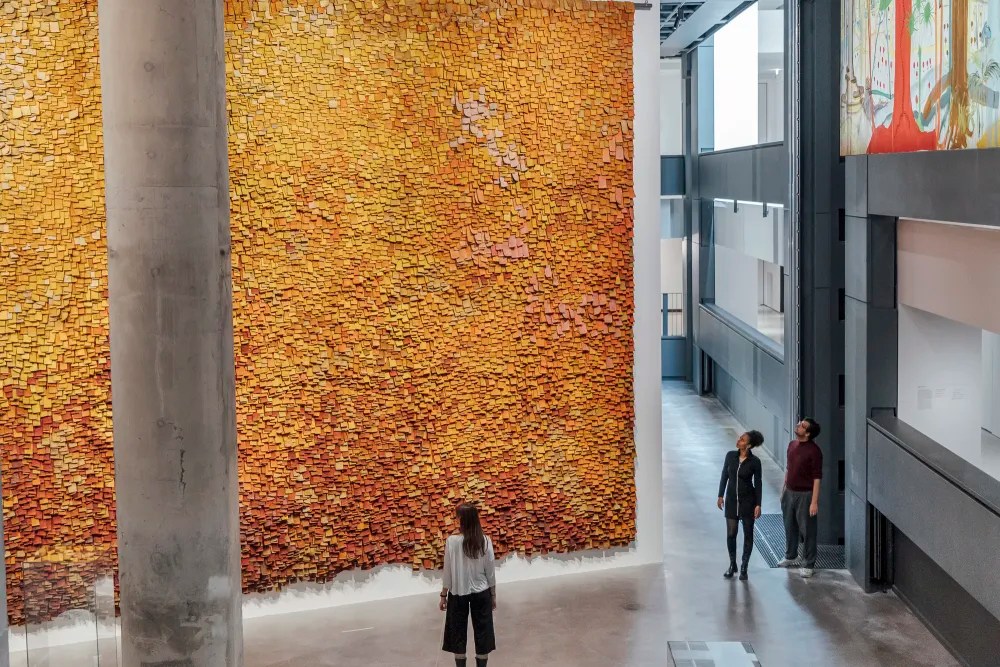
Paris has a new cultural magnet. In October, the Fondation Cartier pour l’art contemporain opened the doors of its dramatically reimagined home directly opposite the Louvre on the Place du Palais Royal. Housed in the former Louvre des Antiquaires, a Haussmannian building whose stately façades have long anchored this historic corner of the city, the Fondation has been stripped bare and transformed by ‘starchitect’ Jean Nouvel, who has created a space as striking for its architecture as for the art it contains. From the outside, the building appears transparent, airy, almost delicate, yet inside it is a marvel of structural ingenuity. Nouvel has hollowed out the interior to create a soaring, flexible expanse punctuated by five modular platforms suspended by cables and pulleys, allowing the space to adapt to monumental installations, intimate works, or complex multi-level arrangements. It is as though the building itself has become a giant Parisian studio, constantly reshaping itself around the artworks on display.
The inaugural exhibition, Exposition générale, brings together around a hundred artists from all corners of the globe, offering a panoramic view of forty years of contemporary art and reflecting the Fondation’s commitment to diversity, experimentation, and international dialogue. Visitors encounter Colombian weaver Olga de Amaral, whose vibrant textile works evoke both history and modernity, Aboriginal painter Sally Gabori, whose luminous canvases capture the spiritual topography of her homeland, and Chéri Samba, who maps Africa at the center of the world. British superstar Damien Hirst presents his distinctive conceptual works alongside American painter Joan Mitchell, whose gestural abstraction pulses with energy, demonstrating the Fondation’s mission to place Western and non-Western, historical and contemporary artists, emerging and established, on equal footing. The exhibition presents a living map of contemporary creation, refusing conventional hierarchies of fine arts and emphasizing dialogue across cultures, forms, and media.
The Fondation’s collection, amassed over four decades and now comprising over 4,500 works by 500 artists from more than sixty nationalities, is at the heart of this presentation. Exposition générale gathers emblematic pieces and selected elements from past exhibitions, weaving them into a coherent narrative that showcases the diversity of approaches, techniques, and ideas that have shaped the institution since its creation in 1984.
Organized around four thematic threads, the exhibition highlights the Fondation’s guiding principles: architecture, nature, experimentation, and the integration of technology, fiction, and science into artistic expression. The first thread, Machines d’Architecture, presents architectural models, drawings, fragments, and installations that interrogate urban space, spatial imagination, and the intersection between art and city planning. It invites visitors to consider architecture not as a static backdrop but as a living, interactive system that shapes human experience. The second theme, Être Nature, examines the relationship between humans and non-human life, highlighting endangered ecosystems, the limits of anthropocentrism, and the role of art in fostering environmental awareness. Making Things celebrates experimentation, showing how artists blur the boundaries between art, craft, and design to rejuvenate plastic arts and challenge traditional categories. The final theme, Un Monde Réel, combines technology, fiction, and scientific knowledge to explore new ways of seeing, interpreting, and experiencing the world, offering visitors a multi-sensory, multidimensional encounter with contemporary creation.
The exhibition design, realized in collaboration with Formafantasma, enhances Nouvel’s architectural vision. Modular textile structures with integrated lighting serve both as display supports and as wayfinding guides, drawing attention to the spatial mechanisms behind the exhibition itself. The layout encourages wandering, discovery, and dialogue between works, allowing for moments of surprise and reflection. Floating galleries juxtapose the forests and mythologies of artists from Vendée and the Venezuelan Amazon, demonstrating the potential for unexpected encounters across continents, climates, and cultural traditions. These works extend beyond the building into the city itself: installations in the Galerie Valois and the Place du Palais-Royal echo the exhibition’s themes, creating a porous relationship between museum and metropolis and reasserting the Fondation’s commitment to civic engagement and public accessibility. Italian designer Andrea Branzi’s drawings for Grand Paris, developed with Stefano Boeri, are presented in the Galerie Valois, illustrating urban futures and reinforcing the exhibition’s dialogue between art, architecture, and civic imagination.
The building’s history resonates with the exhibition’s ambitions. Originally conceived as the Grand Hôtel to accommodate visitors to the 1855 Exposition Universelle, it later became the Grands Magasins, retail palaces where art and commerce coexisted, and then the Louvre des Antiquaires, where long corridors and display windows staged exhibitions of art and decorative objects for an international clientele. Each iteration of the building contributed to its identity as a site for public encounter. Nouvel’s redesign honors this legacy, maintaining continuity between past and present while opening the Fondation to new forms of engagement.
Visitors are invited to move fluidly through the space, observing and re-observing works in different spatial and conceptual contexts. Panamarenko’s visionary projects, from Panama, Spitzbergen, Nova Zemblaya to other kinetic and imaginative structures, coexist with Alessandro Mendini’s sculptural experiments and Peter Halley’s geometric abstractions, creating layers of reference, memory, and experimentation.
Jean Nouvel’s architectural intervention amplifies these curatorial ambitions. Visitors can step back and take in 360-degree views across the immense volumes of the building, seeing multiple artworks simultaneously while also glimpsing the city through expansive windows. Fabrice Hyber captures the effect of the space: “It’s not easy, it’s huge, so it had to be opened. Every time you see an artist, it feels like a new world.” The building itself becomes an active participant in the exhibition, mediating between art, visitor, and city, reflecting a vision of contemporary art as something expansive, interactive, and deeply connected to its context.
The Fondation Cartier’s move from the 14th arrondissement to this central location situates it at the heart of a dense cultural axis, alongside the Louvre, the Comédie Française, the Museum of Decorative Arts, and the Bourse de Commerce, home to François Pinault’s private collection. Belgian director Chris Dercon emphasizes, “The building is worthy of the scale of the collection and its history.” The centrality of the site ensures greater visibility, accessibility, and engagement with the public, while also positioning the Fondation as a node in a network of Parisian institutions that are visited as much for their architecture as for their art.
Exposition générale is thus both a celebration of the Fondation Cartier’s past and a bold step into the future. By reactivating the building’s architectural, social, and cultural heritage, embracing its urban surroundings, and presenting a collection of unparalleled diversity, the exhibition draws a new map of contemporary creation. It challenges traditional hierarchies and positions the Fondation as a living laboratory where art, architecture, and urban space interact in constant dialogue.
–
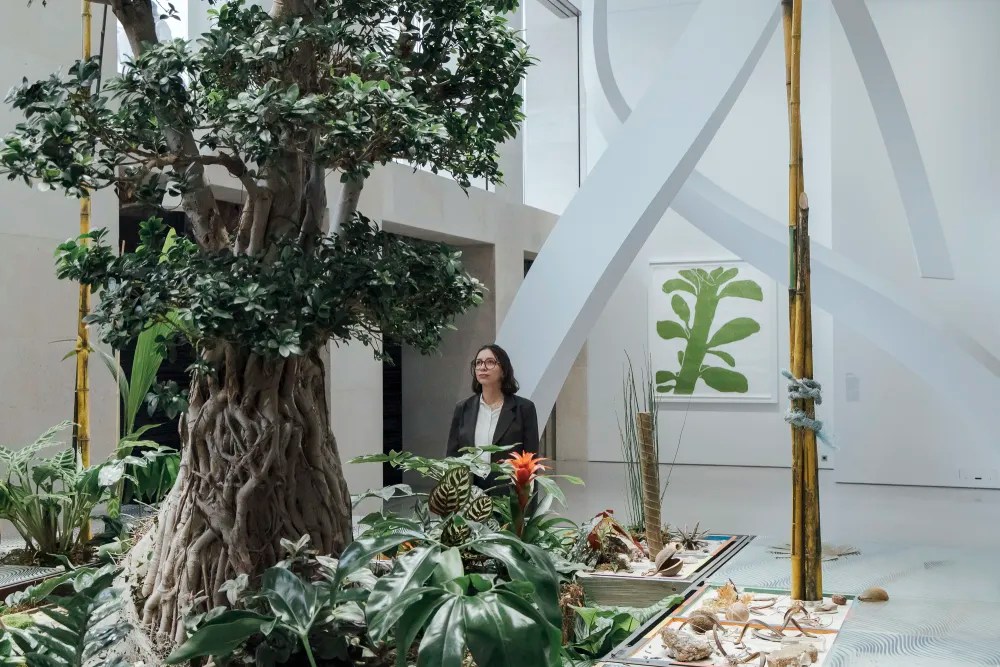
Images: © Olga de Amaral, Muro en rojos, 1982. Photo © Cyril Marcilhacy and © Luiz Zerbini, Natureza Espiritual da Realidade (détail), 2012 © Junya Ishigami, Sydney Cloud Arch, 2018 © Junya. Ishigami+Associates © Santídio Pereira, Sans titre, 2021. Photo © Cyril Marcilhacy
 ART IS ALIVE