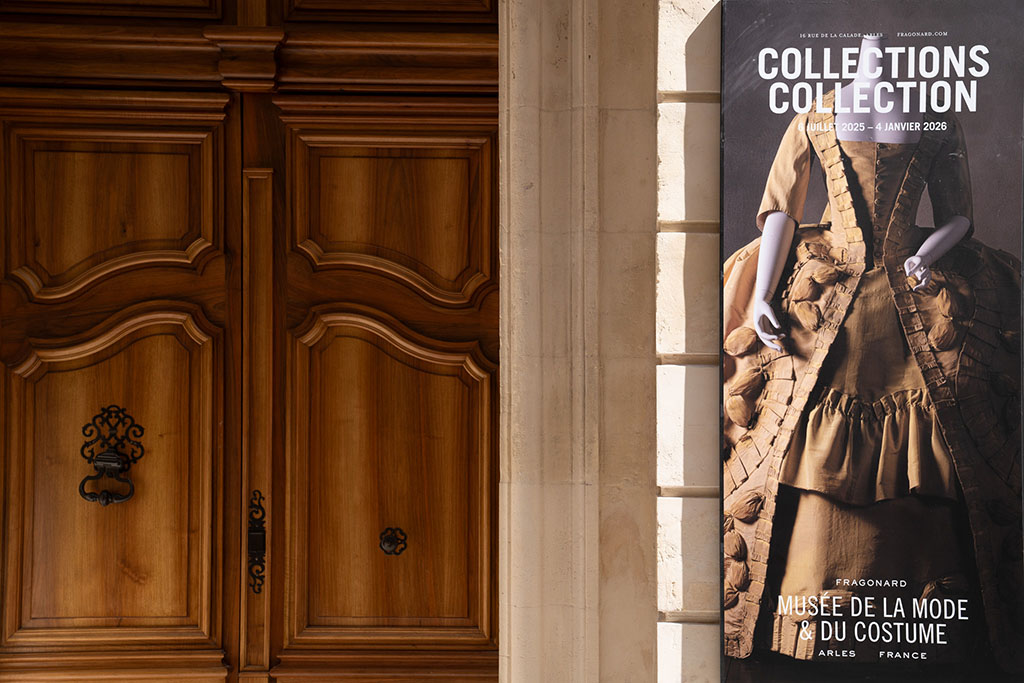
Arles, long celebrated for its Roman amphitheatre, its honey-coloured light and the annual surge of international visitors drawn to Les Rencontres d’Arles, has acquired a new cultural landmark. On 6 July, the doors opened to the Fragonard Musée de la Mode et du Costume, a stunning private museum dedicated to Provençal dress and historical fashion, housed in the meticulously restored Hôtel Bouchaud de Bussy.
Arles itself is a city where the traces of ancient civilisations blend seamlessly with the vibrancy of contemporary culture, a place where artistic genius, and literary ambition intersect. Its streets, once trodden by Roman legions, now echo with the footsteps of artists, writers, and visionaries who have drawn inspiration from its timeless beauty. Designated as a UNESCO World Heritage Site, Arles boasts an impressive array of Roman and Romanesque monuments: the Arles Amphitheatre, constructed in the 1st century AD and still used for performances; the Roman Theatre, dating to the late 1st century BC; the Thermes de Constantine; and the necropolis of Alyscamps, all bearing witness to the city’s deep historical roots.
The city’s cultural influence extends beyond its ancient monuments. Born in Arles, Christian Lacroix has drawn inspiration from its rich tapestry, incorporating elements of Arlesienne attire into his collections, blending traditional craftsmanship with contemporary flair. Actes Sud, established in 1983, has become a literary cornerstone, offering both a publishing house and bookshop where visitors can immerse themselves in diverse literature and meet authors. In 2021, LUMA Arles transformed the city’s skyline, a visionary cultural hub designed by Frank Gehry, housing exhibition halls, research spaces, and event venues set within landscaped gardens. Meanwhile, the Fondation Vincent van Gogh celebrates the artist’s time in Arles, curating exhibitions that explore connections between Van Gogh’s masterpieces and contemporary art and science. And so much more.
The Fragonard project not only elevates the city’s growing status as a cultural nexus but also restores visibility to a figure once as symbolically charged as the Parisienne: the Arlésienne. Her distinctive silhouette, characterised by structured bodices, richly pleated skirts, lace fichus and elaborate hair ornaments, emerged over centuries from the particularities of the Camargue region. Despite the richness of the traditions, it has rarely enjoyed museum space on this scale. The Fragonard museum aims to correct that imbalance.
The institution’s artistic director, Clément Trouche, a 37-year-old Arles native and specialist in Provençal costume, has long been one of the most respected voices in this field. “The inaugural exhibition of the Museum of Fashion and Costume brings together, since 2019, the collections of Hélène Costa and Magali Pascal, two enthusiasts who assembled Provençal costumes and historical fashions from the 18th to the 20th century. Since 2019, their collections have been united by Agnès, Françoise, and Anne, offering a unique perspective on Provençal fashion, blending regional and Parisian influences. The exhibition highlights the dialogue between the pieces, revealing the history and evolution of the Arlesian costume.”
More than a repository of garments and textiles, this project is conceived as a living hub, an intersection of heritage, creativity, and dialogue. It stands in conversation with the Costume and Jewelry Museum in Grasse, home to Hélène Costa’s remarkable collection since 1985, and promises to become a beacon for cultural exchange and discovery. It’s stunning!
The seeds of this museum were planted decades ago in the imaginations of Odile and Magali Pascal, both collectors and historians of costume. Their dedication to preserving and interpreting the sartorial past first captivated the public during the 1997 exhibition “Collection d’une Arlésienne”, revisited in 2015, which invited the Côte d’Azur audience to experience the silhouettes that had long lived only on the pages of books. Years later, just before Magali Pascal’s passing, the Costa sisters envisioned safeguarding this extraordinary legacy through a new, permanent project. Arles made sense to host the collection.
Merged in 2019 under the protection of Maison Fragonard, the two collections offer an expanded vision of fashion since the Ancien Régime, spanning the towns and territories of the French Mediterranean basin. These years of collecting and research have given rise to many discoveries vital to understanding the history of Provençal fashion. The daughters of Hélène Costa continue to uphold the family passion through their Grasse museum exhibition programme and of the textile collection, while Magali and Odile Pascal have published three international reference works on the history of Arles costume, uniquely illustrated by the mother-daughter/model-photographer duet themselves.
Maison Fragonard’s relationship with the city began earlier with the opening of a maison d’hôtes on rue du Palais, a fantastic property restored with vintage tomettes, carved medallions, marble fireplaces and a rooftop terrace overlooking the tiled roofs of the old town. Simply beautiful. Arles, they argue, is an ideal setting for their multidisciplinary approach, one that merges design, craft, floral art and now fashion scholarship.
The museum’s home, the 17th-century Hôtel Bouchaud de Bussy, is itself a lesson in Arlesian history. Originally built for a line of royal counselors and naval officers, later converted into a maternity hospital and then a modest hotel, the property’s many layers have been carefully preserved by Studio KO, the Paris- and Marrakech-based architectural practice known for the Yves Saint Laurent Museum in Marrakech and numerous high-end residential projects, led by its founders Karl Fournier and Olivier Marty. Their work in Arles is discreet but exacting: stone staircases stripped back to their original grain, vaulted rooms revealed after decades of partitioning, and new interventions designed to appear almost immaterial. Very impressive.
This minimalism serves the curatorial concept. Clément Trouche talks to Art is Alive: “The first priority was the protection and preservation of the works. The second was to make visitors lose their sense of time and space so they could feel in direct contact with the pieces without distraction. Studio KO then proposed a complete scenography and museography that responded perfectly to these requests. They worked to make the entire process as invisible as possible, without neglecting a single detail. Everything was designed and thought out down to the smallest element, executed with exceptional precision fully in line with their reputation.”
Studio KO’s display amplifies garments, paintings and objects on display: “Thanks to their design of display cases that seem to pass straight through the gallery walls, to the mirror effects that create at times surreal reflections, and to the quality of the lighting work, the pieces become like jewels in their case… I could never have dreamed of a more beautiful collaboration!” Trouche continues.
Karl Fournier and Olivier Marty, founders of Studio KO write: “To set out in search of a vision, with no guarantee it is the right one. To find a narrow path, a thin line drawn between two certainties: the power of the clothing, the power of the architecture. To step into a cloud made of dust and nothingness. The soft fragility of the fabric, the rough porosity of the stone, two forces united in a single elegance. To listen, at last, to the murmur of the centuries.”
The museum’s inauguration drew nearly four hundred guests, costume experts, fashion historians, local dignitaries and friends of the Maison. Trouche recalls the opening week: “The very first highlight was undoubtedly the final touches completed just hours, or even minutes, before the opening of the doors, and especially the feeling that came with seeing the first visitors enter the museum. Nearly 400 guests… gathered to discover this new space dedicated to the history of costume and fashion.”
The celebrations culminated in a theatrical banquet staged directly on the arena floor of Arles’ ancient theatre, a remarkable moment for the city: “a unique sensory experience imagined by the chef Fabien Vallos… a magical week, marked by emotion, culture, and sharing.”
Since opening, the museum has already attracted a global audience drawn by curiosity for regional fashion, for Fragonard’s expanding cultural ecosystem, and for the inventive pairing of heritage with contemporary museography. “We are dazzled by the reception it has received! Visitors from around the world are flocking to the museum. The attention and appreciation from major fashion and museum professionals for our institution and the work accomplished is more than encouraging for the future.”
The period represented, from the 18th to early 20th centuries, is one of enormous transformation in French dress. Yet the Arlésienne silhouette remained distinct: the black shawl or fichu, the ruban tied above the forehead, the shaping of the bodice, and the particular choreography of pleats all formed a coded language. Local variations signalled a woman’s age, marital status and social circle. Trouche’s display juxtaposes Provençal garments with Parisian influences, demonstrating how regional identity was negotiated, adapted and performed.
The Fragonard museum strengthens an already dynamic cultural map and other cultural spaces that belong to the house in Grasse. Within minutes’ walk lie the Musée Réattu, the Museon Arlaten ethnographic museum founded by Frédéric Mistral, the Departmental Museum of Ancient Arles, and architectural landmarks from the amphitheatre to the cryptoporticus. Add to this contemporary art foundations, residencies, festivals and an increasing number of design-forward boutiques and restaurants, and Arles presents a rare blend of deep antiquity and contemporary experimentation.
Maison Fragonard’s presence anchors this further. The maison d’hôtes showcases Provençal craftsmanship with fascinating interiors curated personally by Agnès and Françoise Costa, while the ground-floor boutique features terrazzo floors by local artisans and lighting by Atelier Vime. Across these spaces, the company’s prints, floral compositions and furnishing collections create a sensorial throughline linking perfume, design and hospitality.
Ultimately, the new museum positions the Arlésienne not as a relic of folklore but as a complex cultural figure whose clothing expressed regional pride, artisanal skill, and nuanced femininity. In giving her a dedicated home, Fragonard reopens a chapter of French fashion that had long remained in the shadows, and offers visitors a narrative that stretches far beyond aesthetics, into anthropology, craft history and community memory.
The museum is open year-round, deepening Arles’ appeal beyond the summer season. For Trouche and the team behind the project, this is only the beginning.
Running until January 5, 2026, the exhibition “Collections-Collection” offers an exploration of pieces gathered over time through passion. A patterned dress from the late Directoire period, another in French silk from the 1780s, a fichu with a yellow print that the collective imagination immediately associates with Provence, yet whose aesthetics historically originate from Indian and Persian cotton fabrics.
The exhibition features beautiful caracos, women’s jackets crafted from printed cotton fabrics around 1780, alongside elegant capes in chintz from the mid-1780s. Exquisite men’s waistcoats in patterned silk velvet from the 1830s and 1840s are displayed alongside head-dress ribbons of silk velvet dating from 1840 to 1850. Numerous accessories, antique jewelry, and finely worked textiles enrich the presentation, while the iconic costume of the Arlésienne takes center stage, celebrating the beauty, variety, and meticulous craftsmanship of traditional Provençal attire.
Among the highlights is Portrait of an Arlesian in the Amphitheater by Jules Salles (Nîmes 1814–1900), a captivating homage to the city and its enduring classical legacy. Two works by Arlesian engraver Jean Joseph Balechou (1715-1764) are also on view: on the left, Sainte-Geneviève Patrone de Paris dédié au Roy, based on the painting by Carle van Loo, and on the right, Les Baigneuses dédié à Monsieur Poulhariez Négociant à Marseille, based on the painting by Jean-Joseph Vernet (1714-1789). Balechou and Vernet were both students of another illustrious native of Arles: the painter Philippe Saudan (1697-1792). Portrait de Monsieur Noguier à son bureau, The portrait of the merchant from the Trinquetaille quarter of Arles embodies the quintessence of Antoine Raspal’s talent as a painter. Its format, composition and the armchair used, echo the Portrait de Madame de Privat et ses filles preserved at the Museon Arlaten, as well as Raspal’s Autoportrait, entouré de sa famille, preserved at the Musée Réattu in Arles.
In the former stables, the room with its seven-meter-high ceiling houses a video commissioned from the artist Charles Fréger, showing the different stages of preparation through several women filmed as Chinese shadows. Traditional and contemporary, it forms a perfect echo of the architecture.
On the upper floor, visitors discover a more freely arranged scenography featuring around forty mannequins, both male and female. Visitors witness the birth of a specific Provençal dress style and its continual adaptation to successive fashions. The garments distinguish themselves from Parisian trends without ignoring them.
Connoisseurs will recognize the wide sleeves of the 1840s, the crinolines a decade later, followed by bustles, and finally the silhouette of 1900. Each style harmonizes with local fichus, headdresses, and jewelry. Spanish influence, closely linked to Arles’ culture, is also clearly present. The exhibition situates itself midway between regional dress and the couture of the capital. Indeed, it is the luxury costume that has best endured the years.
Push the doors and you’ll see the majestic staircase and golden carpet.
The Reine d’Arles (Queen of Arles) is a prestigious cultural title awarded every three years to a young woman from Arles or its surroundings who embodies the region’s heritage and traditions. Established in 1930 to honor the legacy of Nobel Prize-winning poet Frédéric Mistral, the title recognizes candidates aged 18 to 24 who are fluent in Provençal and knowledgeable about local history, arts, and culture. The selection process culminates in a public ceremony in May, with the queen formally inaugurated during the Fête du Costume at the Théâtre Antique, where she dons the iconic Arlésienne costume. Throughout her reign, she serves as a cultural ambassador, participating in parades, festivals, and ceremonies, promoting the traditions and pride of the region. The most recent queen, Amélie Laugier, was elected on May 8, 2024, marking the 25th reign. This enduring tradition remains a vibrant celebration of Arles’ identity and heritage.
In addition to the museum, the Fragonard boutique at 7-9 Rue du Palais in Arles, has introduced a special line of soap dedicated to the city of Arles. The Belle d’Arles soap pays homage to the Camargue capital, capturing the essence of the region with its delicate notes of neroli. The soap’s design, reminiscent of an antique bas-relief, adds a touch of elegance to any setting, celebrating the heritage of this wonderful city.
The museum will continue to evolve, with rotating displays, research initiatives and future collaborations aimed at bringing Provençal fashion, and all its overlooked intricacies, to a broader public. From simple manufacture, Fragonard has become in nine decades a universe comprising today 3 factories, 6 museums and 24 shops.
–


Images: © Musée Fragonard, and François Deladerrière.
Thank you to Marie Lepeudry, Clément Trouche, Charlotte Urbain, Nhi Vu and everyone at Fragonard.
 ART IS ALIVE