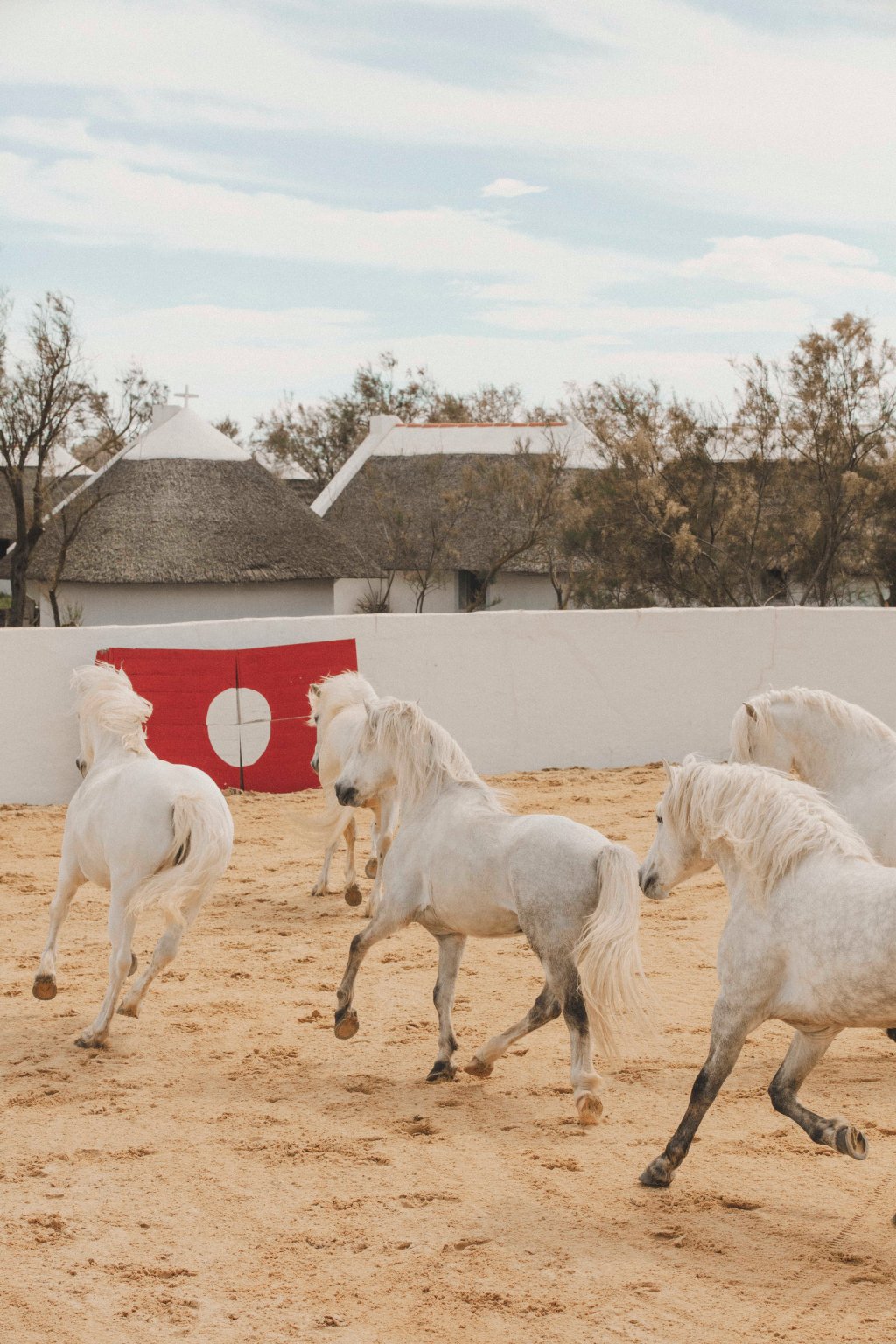
At the edge of Provence, where the Rhône branches into a fan-shaped delta before reaching the Mediterranean, lies a landscape unlike any other in France. Camargue is a place of wide horizons where flamingos roam freely and herds of white horses splash through salt marshes. At its heart is Les Saintes-Maries-de-la-Mer, a fishing town and pilgrimage site blending history, folklore, and Mediterranean light. Its fortified church dates back to the Middle Ages. Its sandy beaches stretch endlessly, and the annual Gipsy pilgrimage in honour of Sainte Sarah draws thousands each May.
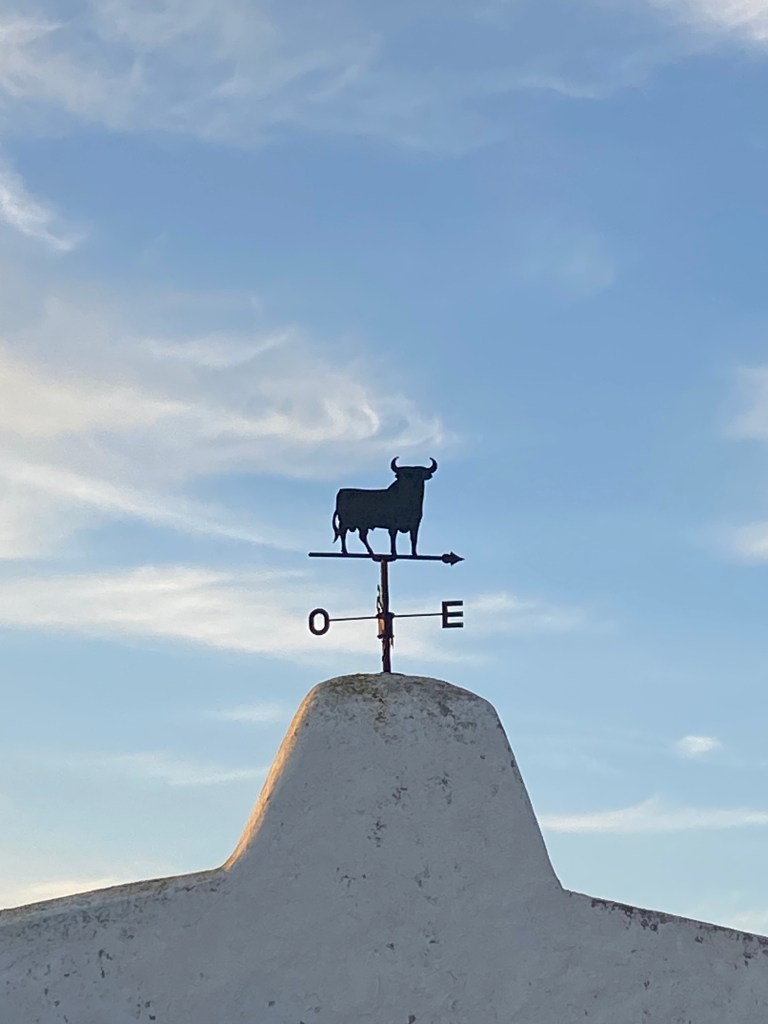
Just 30 kilometers away lies Arles, once a Roman stronghold and now a cultural capital with Roman churches, contemporary art museums such as the LUMA Foundation, and the iconic Rencontres d’Arles photography festival. Vincent van Gogh arrived here in 1888, capturing the vibrancy of the delta in paintings of wheat fields, cottages, and skies streaked with Provençal light. He welcomed Gauguin with whom he had a serious argument too and painted the church of Saintes-Maries-de-la-Mer. Artists, writers, and filmmakers (including Julian Schnabel) have followed, drawn to a landscape that feels both eternal and cinematic. Arles and Camargue are both infused with a subtle Spanish flair.
Into this setting, where nature and culture meet, Les Bains Gardians were reborn. This is a stunning retreat in Saintes-Maries-de-la-Mer that fuses the DNA of its founder’s iconic Parisian institution, Les Bains Douches, with the wild beauty of the natural landscape. Les Bains Gardians are a distinctive place and it’s ultra cool.
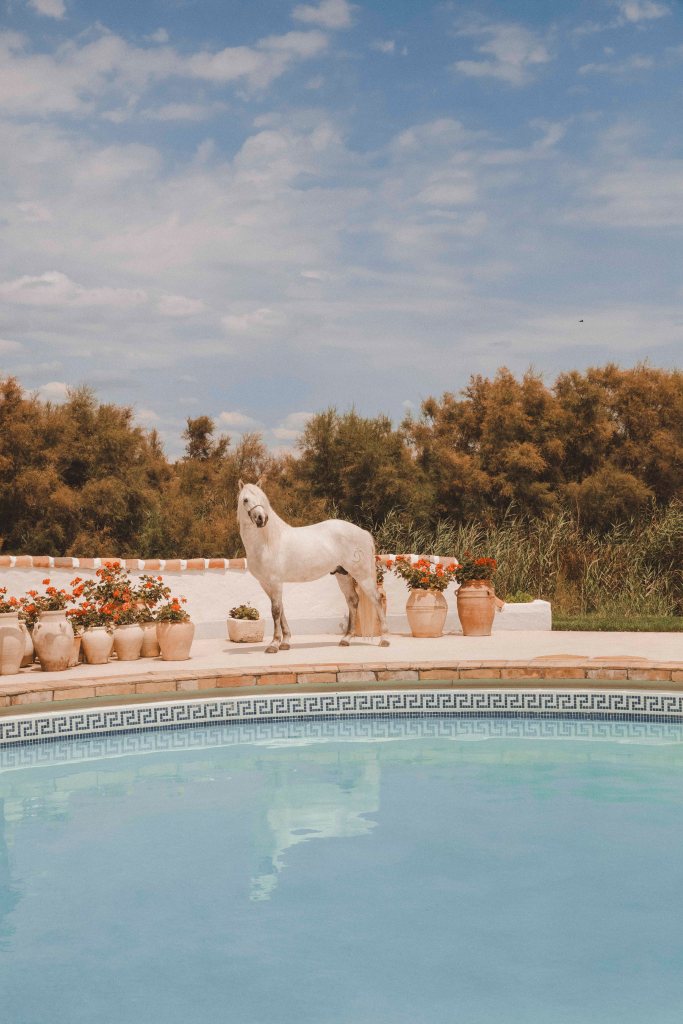
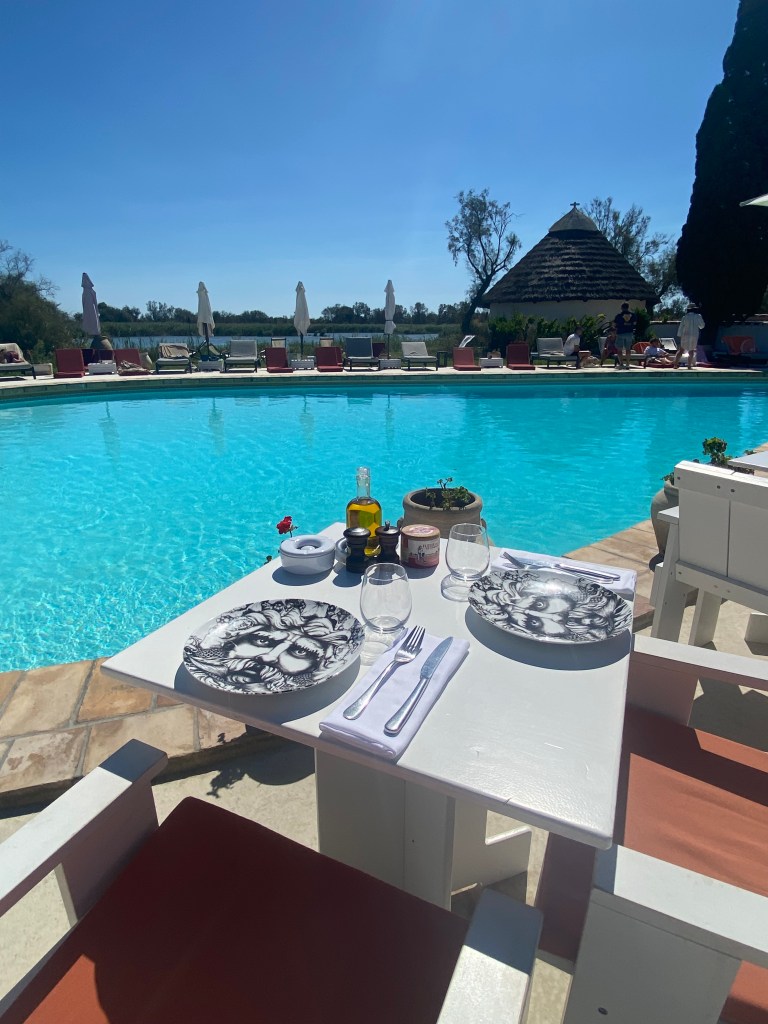
The stylish resort brings together horses and stables, a stunning private arena, two large and gorgeous swimming pools, tennis courts, a restaurant, a cocktail bar, chic red sunbrellas, alongside a programme of artistic commissions and musical events. It’s an oasis in the middle of nature, a 4-minute drive from the Ornithological Park of Pont de Gau.
Jean-Pierre Marois, esthete, literature-lover, and businessman, owner of Les Bains Gardians, creates his hotels the way he once made his films: to tell stories. “Here, the script is about reconnecting with a landscape that is authentic, inspiring, and powerful,” he explains. “Guests wake up to flamingos taking flight over the ponds, before riding a horse along the beach or lounging by the pool, gazing at the endless stretches of the regional park. It’s responsible tourism, paired with the hedonism that defines us: art, music, fine cuisine, excellent drinks.”
The environment of the hotel is indeed very cinematic: “Hotels are vessels for storytelling. Every day, unlike cinema where a film is finished once released, we reinvent the experience with the team, striving to make each performance better than the last. This theatrical dimension is incredibly rewarding, both artistically and personally.”
Jean-Pierre reflects on its location: “We’re only 25 minutes from Arles, with its cultural life, and close to the airports of Montpellier and Marseille. The sense of seclusion is part of the magic.”
Jean-Pierre’s own relationship with the Camargue began almost by chance. “I was still based in Paris when I started thinking of opening a hotel in the south of France. At first I was looking more toward Saint-Rémy-de-Provence or Saint-Paul-de-Vence. Then a broker suggested Camargue. I came on January 3rd, deserted, freezing cold, but with a bright blue sky. I found it incredible, because the place had such character and originality.” He already knew the area through friends. “I realised how much this environment, with its unique microclimate and protected natural environment, stayed with me.”
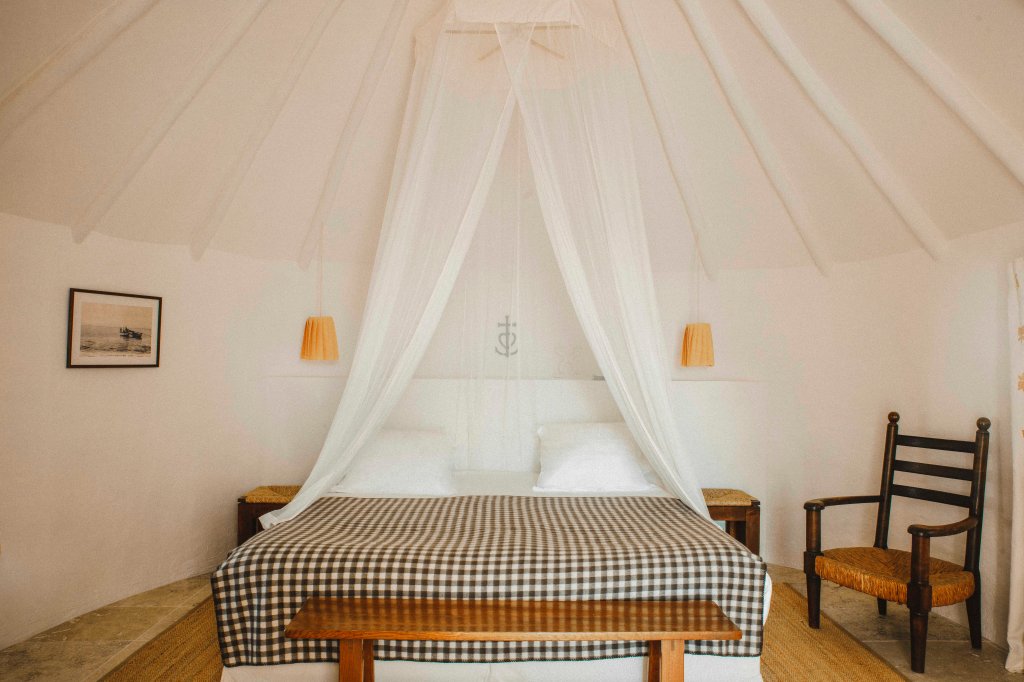
The property offers 67 rooms, including approximately 50 authentic Cabanes de Gardians i.e cute, traditional horse and bullkeepers’ houses, and a beautiful farmhouse with accommodations overlooking the ponds.
For Jean-Pierre, the power of the site lies not only in the estate itself but in its environment. “I saw other hotels for sale in the provinces that were very attractive, but in the end the setting wasn’t that great. Here, it’s truly powerful… There are expanses of water, some as large as small lakes. They feed into the Rhône estuary, which creates a very particular microclimate. The hotel itself is on land classified under the urban planning code as a protected natural area. This is what makes it special: it’s a constraint but also its strength.”
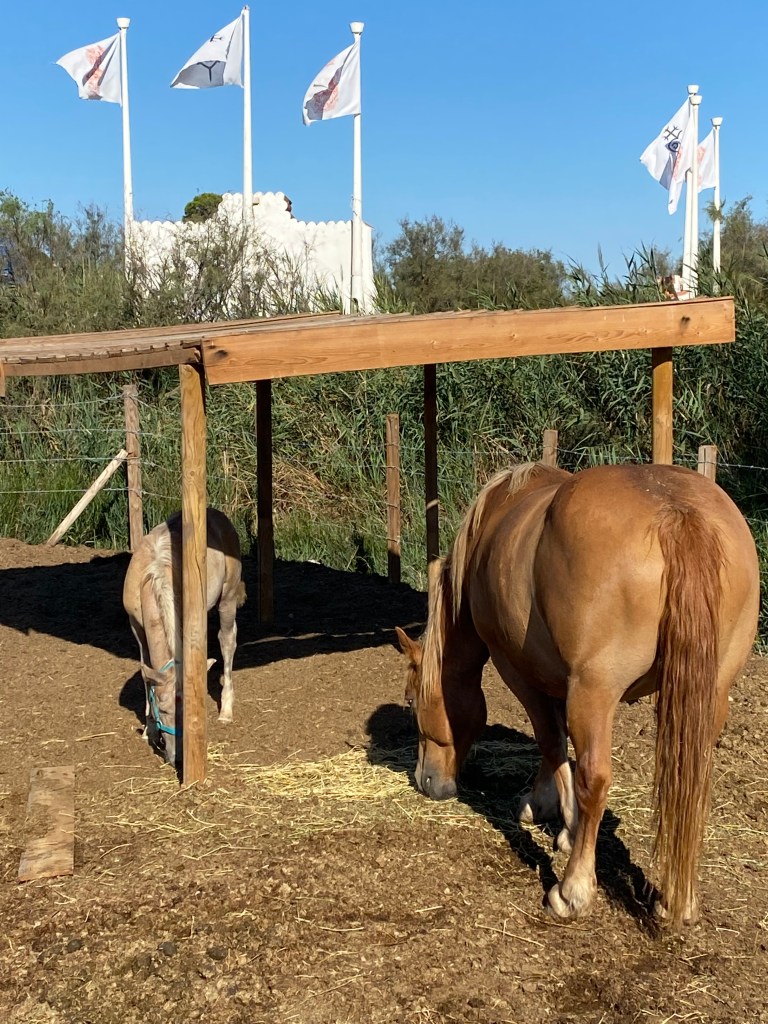
The property’s soul is equestrian too. Guests have options to gallop along the wild beaches of Saintes-Maries-de-la-Mer on a Camargue horse, or explore the ponds on a horse-drawn carriage, discovering the local flora and fauna. There’s a truly exhilarating sense of freedom at Les Bains Gardians: “I know how to ride, I have ridden, I enjoy horseback riding. But I wasn’t one of those people who always dreamed of owning an equestrian estate,” Jean-Pierre admits. “Again, I’m more of a Parisian, this wasn’t a lifelong project of creating a hotel with horses, to be riding every day, etc. But when I discovered this estate and saw that at the very heart of the hotel there were these stables that are truly beautiful, I knew it was the place… Magnificent, really.”
The arena is fantastic, more than a thousand square meters, open to the sky. “All the paddocks create stunning views, so that when you’re in the rooms you see a horse walking right past your window. The Camargue horses are very beautiful, quite elegant, you can’t help but fall under their charm. All of that is exceptional.”
Today, the hotel stables house 25 horses, and guests can ride directly from the property into the Camargue Regional Park, crossing wild lagoons and finishing on the beach. The hotel was originally built in the 1960s, when the Camargue was fashionable and often used as a backdrop for French-style westerns. “Over time, successive owners made changes, some more fortunate than others. Our task was to erase them and reconnect with the pure Camargue style,” Jean-Pierre explains. That meant restoring roofs, plumbing, electricity, and interiors while respecting ecological standards and sourcing vintage tiles and furniture.
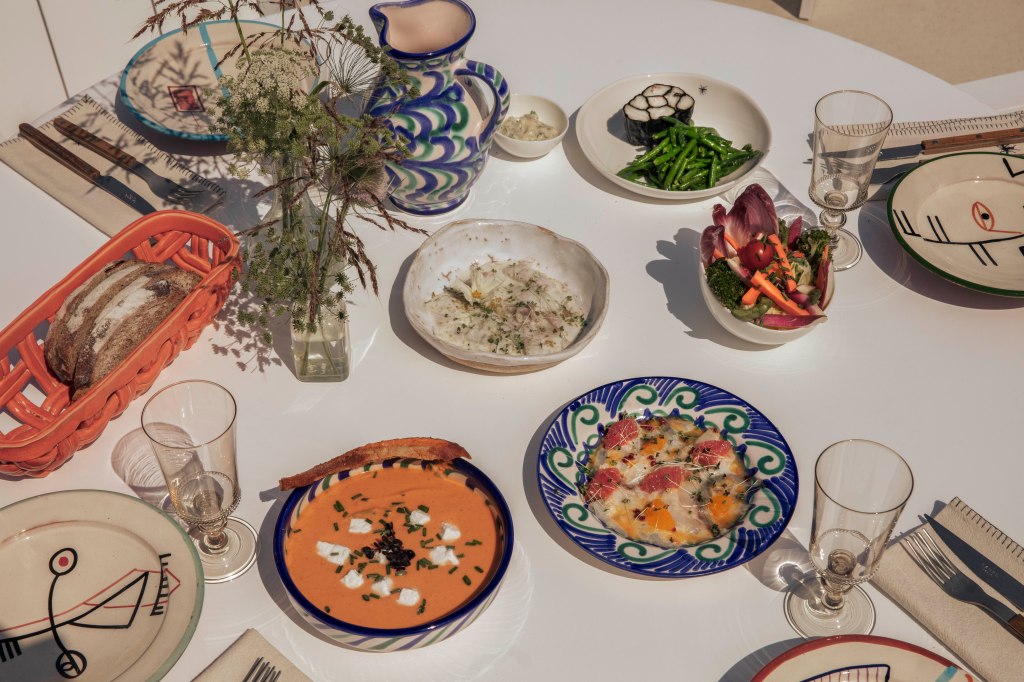
The result is simply perfect: whitewashed accommodations with curved backs facing the mistral, and standing scattered among canals, each with a private terrace overlooking water, blue topography on the walls designating each space, azulejos, and Les Bains’ logo featured at the entrance and on the plates of the restaurant.
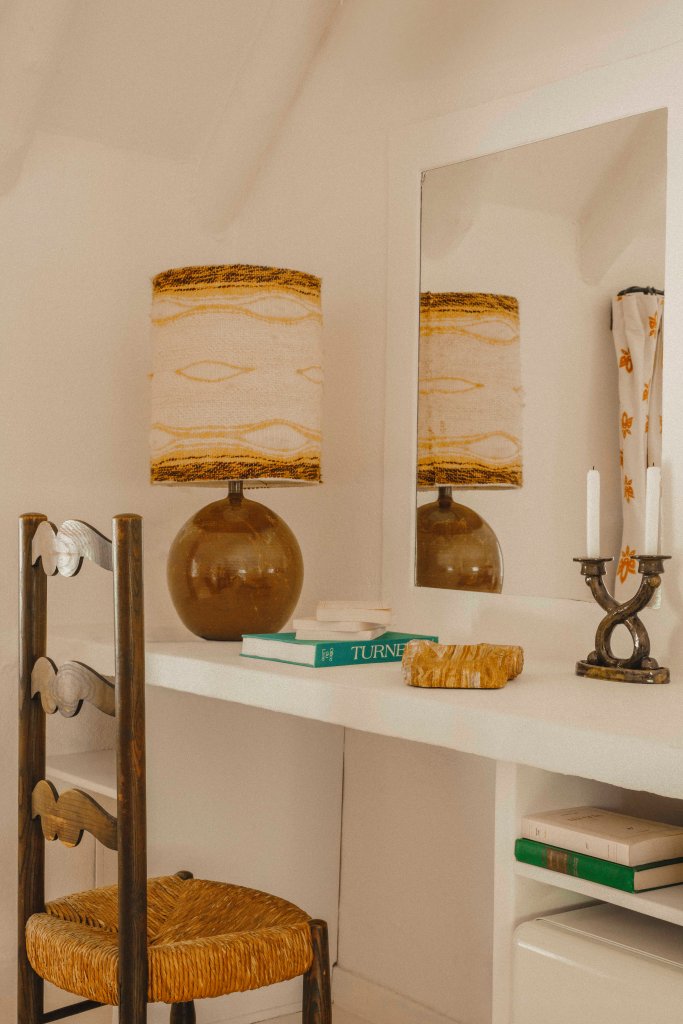
Interiors by Hauvette & Madani (the Paris-based interior design duo, have garnered acclaim for their eclectic and refined approach to interior architecture) are minimalist and tactile. They feature mosquito-net canopies, with vintage wooden stools, and textured plaster walls, elevating rustic simplicity to refined luxury. Inside the houses, subtle touches of orange accent the bathrobe. Toiletries by Terre de Mars add a refined, natural note, and the bathroom tiles, evoking bulls, horses, and cicadas, bring more local character into the space. Curtains by Les Indiennes de Nîmes, balancing tradition with elegance.
“The renovation (the property was acquired in 2022 and lasted for a year and a half) aimed to restore the spirit of the original 1960s estate while keeping its authenticity intact. Old terracotta tiles were sourced to replace ugly flooring, and antique furniture was carefully selected to evoke the feeling of a place preserved in time, with rustic sobriety punctuated by playful pop touches including a display of Orange Clockwork-inspired sofas on the first floor of the ‘Mas’. To achieve this, the team collaborated with Julie Barrau one of Arles’ best antiquarians, who spent over a year sourcing pieces such as the woven straw chairs that now seem as though they have been there since the hotel’s opening. At the center of the property, the “Mas” houses the restaurant for breakfast, and several suites.
This approach, close to archaeological work, also embraced upcycling: around 75% of the acquisitions were second-hand, reducing environmental impact while giving objects a new life. “Hotels are often highly polluting, not only through tourism and water consumption but also through the waste of furniture during renovations. Here, we chose to minimise that impact by reusing and reimagining,” Jean-Pierre explains. The result is an atmosphere both genuine and vibrant.”
All modern comforts are present, yet the atmosphere remains timeless. In each ‘casita’, a curated selection of novels and art books completes the picture.
The culinary heart is the revival of Le Pont des Bannes, a local institution, now serving Camargue-inspired Mediterranean cuisine such as tellines shelfish, bull stew, sea bass, and rice, alongside a fantastic cocktail and wine menu. Sunday brunch is also an option.
If Camargue provides the setting, the soul of Les Bains Gardians is inseparable from the Parisian legacy of Les Bains, one of the most legendary nightlife institutions, frequented by everyone from David Bowie, De Niro, Jack Nicholson, to Andy Warhol, Jean-Michel Basquiat, and Grace Jones. Concerts by then-unknown bands like Simple Minds, Depeche Mode, Joy Division, and R.E.M. sealed its cult status.
By 2010, Les Bains closed, only to be reborn in 2015 under Jean-Pierre’s leadership as Les Bains Paris, a five-star hotel with 40 rooms, a bar, restaurant, spa, and club. The rebirth was such a success that The Michelin Guide called it “one of the most exciting hotel in the world”. It’s true, it’s a mix of rock’n’roll attitude and excellent taste. “In fact what we did here was extract the DNA of Les Bains in Paris, which has an extremely strong history, and we applied it,” Jean-Pierre says. “From the very beginning in Paris, in the 19th century, there was already a man deeply close to the greatest artists of his time. Auguste Guerbois, the original founder, was the owner of the famous café in Batignolles. His friends and clients included Monet, Manet, Renoir, Fantin-Latour, Zola… Zola talked about him in his book L’Oeuvre about a painter named Claude Lantier. Les Bains carried a pedigree of creativity and amazing Haussmannian architecture. They were coined the most beautiful baths of Paris, “a temple dedicated to wellness” according to its founder. Later, in the 1970s and ’80s, it became legendary for its music, clubbing, its concerts, its artists and photography shows. That was the magic of it.”
The art is integral at Les Bains Gardians too, as it always has been with Les Bains Paris. In a region naturally steeped in creativity, Les Bains Gardians instilled the work of artists throughout the spaces. The works, some commissioned, others from the hotel’s collection, enrich the hotel. “Art is central to this project,” Jean-Pierre continues. “Outside stands a vivid sculpture by Benjamin Sabatier, echoing constructivist cardboard. Inside, his canvases of concrete and colored papier-mâché bring striking intensity. These choices draw on the legacy of Parisian venues and speak strongly to our international clientele.”
Residencies always formed a cornerstone of the Paris programme too: “Artists stay with us too. It began with the 2013 initiative, chronicled in the book on that unique adventure with street artists, and continued in partnership with Jérôme Pauchant former director of Galerie Jérôme de Noirmont.” He advised on the collection.
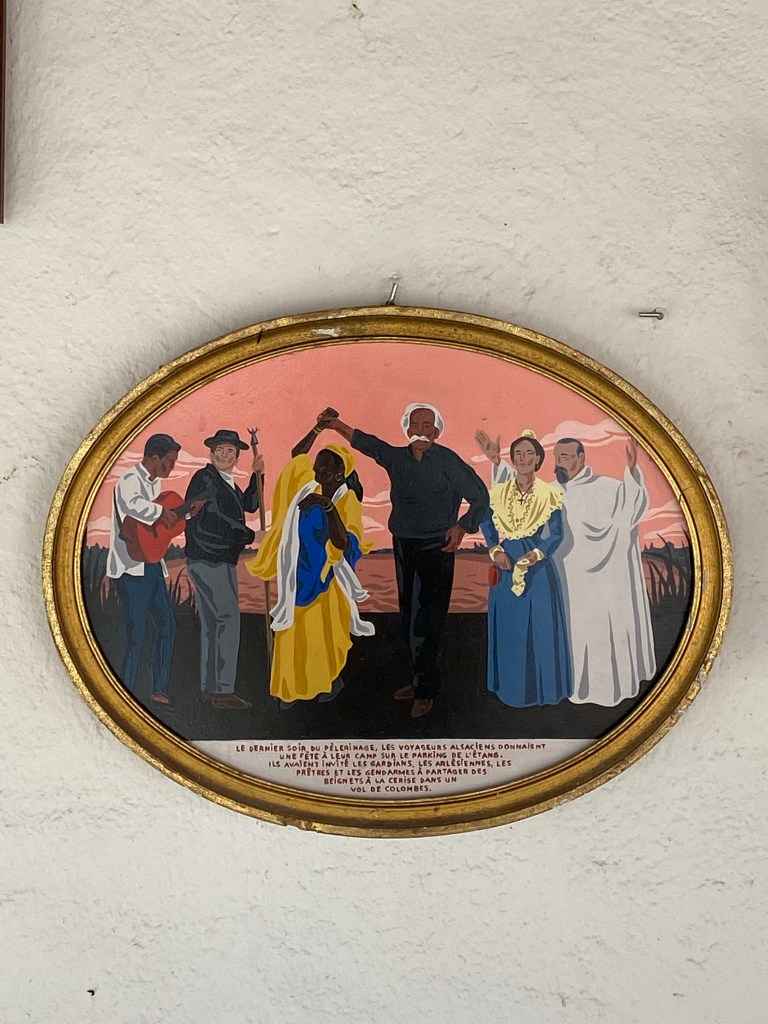
Among recent commissions for Les Bains Gardians: Dove Perspicacius was inspired by the fortified church of Les-Saintes-Maries-de-la-Mer, guardian of Sainte Sarah’s relics and famed 19th-century ex-votos. His notes and sketches became a series of ex-votos, now displayed on the terrace walls of the Restaurant du Pont des Bannes, symbols of fortune and renewal. They reinvent the local folklore with toreadores, the Queen of Arles etc.
Studio Al Fresco, Marseille’s Charlotte Develter and Parisian Zoé de Soumagnat, worked on murals and on the ceiling lights for the restaurant. Their work unfolds in soft, sustainable, solvent-free pastels, reminiscent of Camargue skies.
Perrine Boudy, a recent Villa Arson graduate, has reimagined the restaurant ceilings above the bean-shaped pool. She painted bold swathes of green wash, broken by white squares filled with dreamlike bulls, horses, bridges and stylised floral paths. It’s fun!
“Many artists have left their mark here,” Jean-Pierre adds. “A fresco covers one ceiling, while the restaurant walls display small frames, oval or rectangular, recounting stories gathered from longtime staff, the local priest, and other figures of the community. These vignettes are joyful, and they capture the true spirit of the place.” They mirror an original ex-voto frieze in the main house, a nod to the local bullfight culture.
The second pillar at Les Bains Gardians is the focus on wellness. A spa with whirlpool and treatment room (to be expanded in the future), and wellness options create a genuine sense of disconnection. Les Bains Gardians brings its Parisian heritage of well-being to the Camargue, where letting go is the ultimate motto. “From the start, Les Bains was about a duality: well-being on one side, enlightened hedonism on the other. Not just going to a nightclub with loud music, but entering a club and suddenly catching a private Prince concert for free, or seeing Warhol. That was the magic of it. It was festive but always inspired, a catalyst for personalities and talents. And that’s exactly what we managed to do in Paris, and what we’ve applied here.” It’s sophisticated, with a clientele from around the world.
At Les Bains Gardians, that duality finds a new form. Alongside equestrian activities and immersion into nature, the hotel offers yoga, and an openness to art. Evenings might feature DJ sets in the arena or intimate concerts by visiting artists. In the summer, modern or traditional flamenco (the international Gipsy Kings are from Les Saintes-Marie-de-la-Mer after all) resonate into the space.
Jean-Pierre acknowledges there is still more to do. “The potential is extraordinary. Companies now come here for workshops, with creative brainstorming sessions in the morning followed by Land Rovers’ tours in the afternoon. It’s unique. There is such a strong cultural foundation here that one never feels bored. It is a vast four-hectare estate, so although the transformation has been remarkable, there is still much to complete. We opened gradually: a soft opening began in April with twenty rooms, adding new spaces every two weeks, and by mid-July 2024 the property was fully open, including the restaurant, which only launched then.”
Attention to details is really high at Les Bains Gardians, including at the reception which displays a few products, the Louis Vuitton guide on Arles, a few fashion items and house-made fragrances. Jean-Pierre, who seems to have the Midas-touch, continues: “I founded the fragrance house Les Bains Guerbois, originally established in 1885. The perfume collection, Une Date, Une Histoire, retraces the history of the place through key years: 1885, Les Bains Sulfureux recalls its origins; 1979, New Wave evokes the legendary concerts of Joy Division and Simple Minds; 1992, Purple Night celebrates the evening Prince, after playing to 30,000 people in Bercy, gave an intimate concert for just 150 at Les Bains; and 2015, Le Phénix marks the rebirth of the venue as a hotel after three years of renovation. To create these scents, I collaborated with some of the greatest living perfumers, true masters of their craft. Today the brand is present in about thirty countries and a hundred points of sale, from Le Printemps Haussmann in Paris to Tokyo, Seoul, Hong Kong, Milan, Rome, Turin, New York, and San Francisco.”
Here in Camargue, preservation is essential. “The architecture is not officially listed, yet we consider it our duty to safeguard it. Few traditional cabanes de gardian remain in the region, and we are fortunate to have such an emblematic example. The restaurant building reflects the archetype of a Provençal mas, though the Camargue versions are lower and flatter than those elsewhere.” Alongside this heritage, the four hectares of canals, reeds, tamarisks, olive trees, parasol pines, and abundant wildlife, ducks, swans, even coypus, form a living biotope.
The social fabric here is just as rich. Friends and collaborators have joined. Jean-Pierre mentions his friend Christoph Wiesner, former director of Paris Photo and now head of the Rencontres d’Arles. “With him, we once organized a monograph at the Grand Palais on the photographer Foc Kan, who documented Les Bains for years.” Local artists such as Jean-Pierre Formica have also become part of the circle. “I often meet writers, photographers, and gallerists here, for example, the author Emmanuelle Freche, whom I have known for thirty years, and the gallerist Pierre-Alain Chalier, who runs the Domaine de Lascours with its remarkable sculpture park. Most recently, I visited a special exhibition there of Formica’s furniture works created for the château d’Avignon.”
This region naturally attracts fascinating people. The artist Olivier Urman contributed a piece to our collection and returned this summer. Gradually, a small community hasbullkee formed here. It is a different rhythm from Paris, but equally inspiring. Maripol, who had an influence on the looks of influential artists such as Madonna and Grace Jones also stayed at Les Bains Gardians this summer, over from the US. As part of the 1980s New York downtown scene, she captured the likes of Jean-Michel Basquiat, Keith Haring, Andy Warhol, and Debbie Harry with her Polaroid camera. All coming together as a full circle.
Indeed, the magic is palpable at Les Bains Gardians. In the Camargue delta, Jean-Pierre has created not just a hotel but a scene, an unfolding story where nature, art, and enlightened hedonism converge around a unique arena, chic accommodations and a wonderful swimming pool. Films sometimes merge with reality.
–














Images: credit and copyright Matthieu Salvaing and Nicolas Smirnoff
Thank you to Jean-Pierre Marois, Laëtitia Bizot and the entire staff at Les Bains Gardians
 ART IS ALIVE