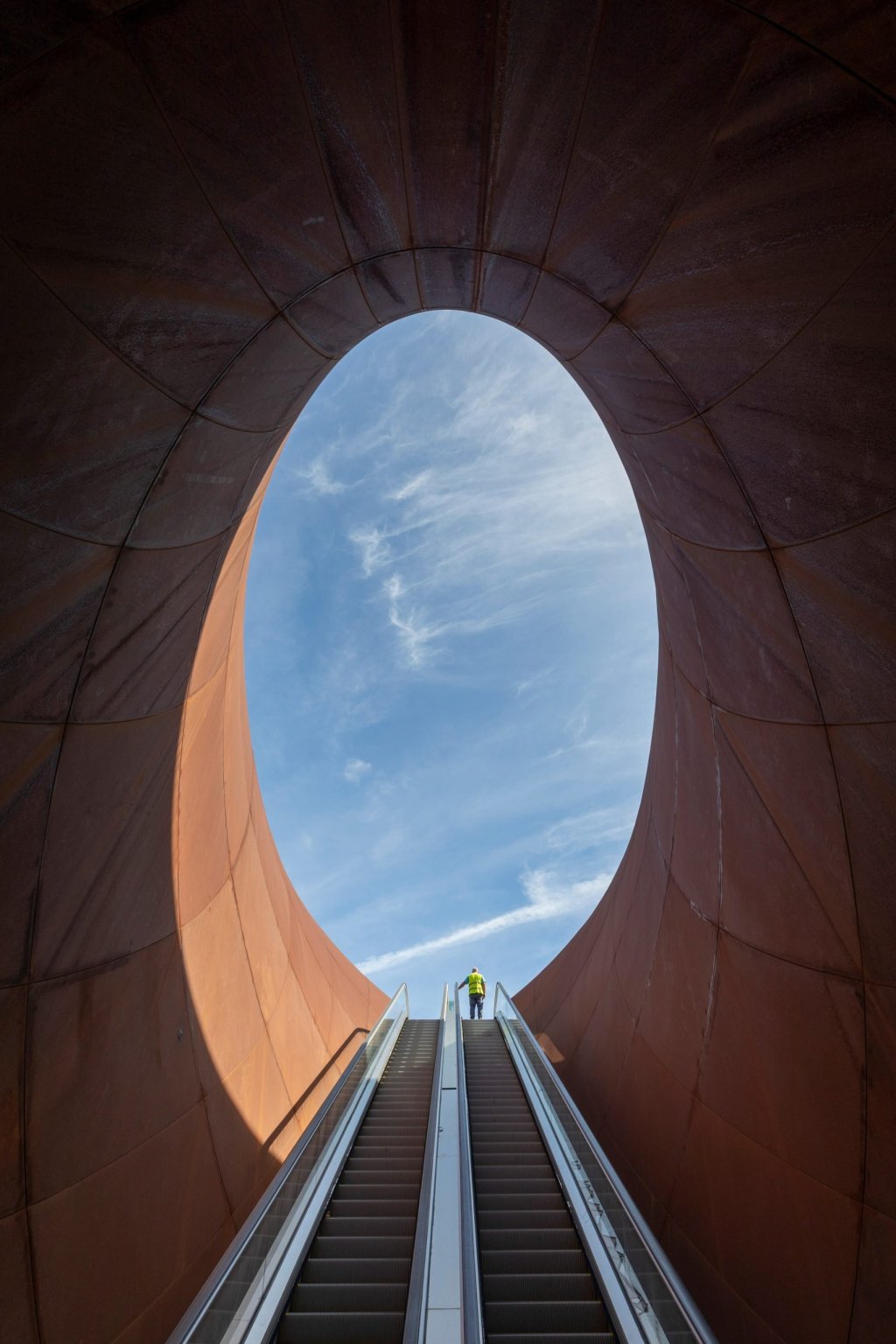
Anish Kapoor’s new Monte Sant’Angelo tube station in Naples, inaugurated on 11 September 2025, stands as both infrastructure and sculpture, a descent into the void that echoes his lifelong explorations of void and the space.
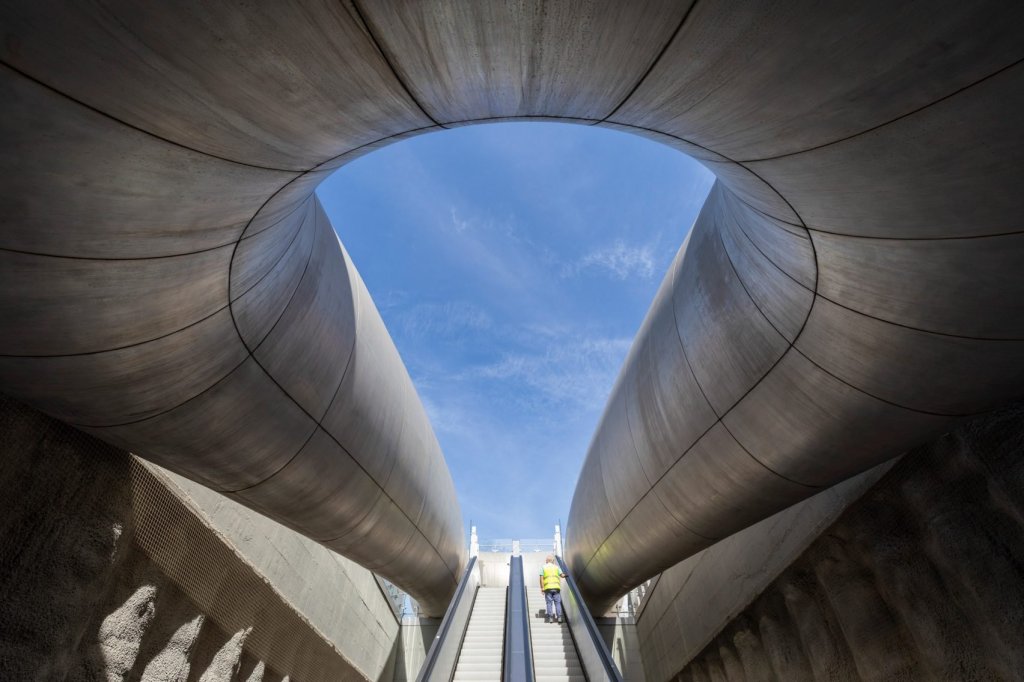
The project, clad in weathering steel with two striking entrances, one smooth and geometric, the other swelling from the ground like an organic organism, forms part of the city’s long-running “art, architecture, archaeology” programme, which has already brought to life stations by Álvaro Siza, Dominique Perrault, Foster + Partners and Benedetta Tagliabue.
Kapoor situates his design firmly in the city’s landscape of Vesuvius and Dante’s Inferno, insisting that the question is not how to go underground, but what it means to go underground. Born in Mumbai in 1954 to an Indian father and Iraqi-Jewish mother, Kapoor moved to London in the 1970s, studying at Hornsey College of Art and Chelsea School of Art, before rising to prominence in the 1980s with his pigment-drenched voids and enigmatic forms.
Representing Britain at the Venice Biennale in 1990 and winning the Turner Prize the following year, he quickly became one of the most visible sculptors of his generation, staging museum and institutional projects of unprecedented scale: a record-breaking retrospective at London’s Royal Academy of Arts in 2009, the ballooning Leviathan inside the Grand Palais for Monumenta in 2011, his controversial Versailles interventions in 2015, and most recently a dialogue with the Renaissance collection at Venice’s Gallerie dell’Accademia in 2022. His permanent works, from Cloud Gate in Chicago to Sky Mirror in Nottingham and New York, have become contemporary landmarks, shimmering surfaces where the viewer is both absorbed and destabilised.
In Naples, the ambition is more civic but no less metaphysical: the station in the Traiano district is intended as a catalyst for regeneration, but also as a daily ritual for commuters who will enter not simply a building but an experience. Users will be moving through thresholds that recall geological time, and the mythic underworld.
In doing so, Kapoor offers the city an artwork that is lived, a sculpture as infrastructure, with a necessary descent to one’s journey.
–
 ART IS ALIVE