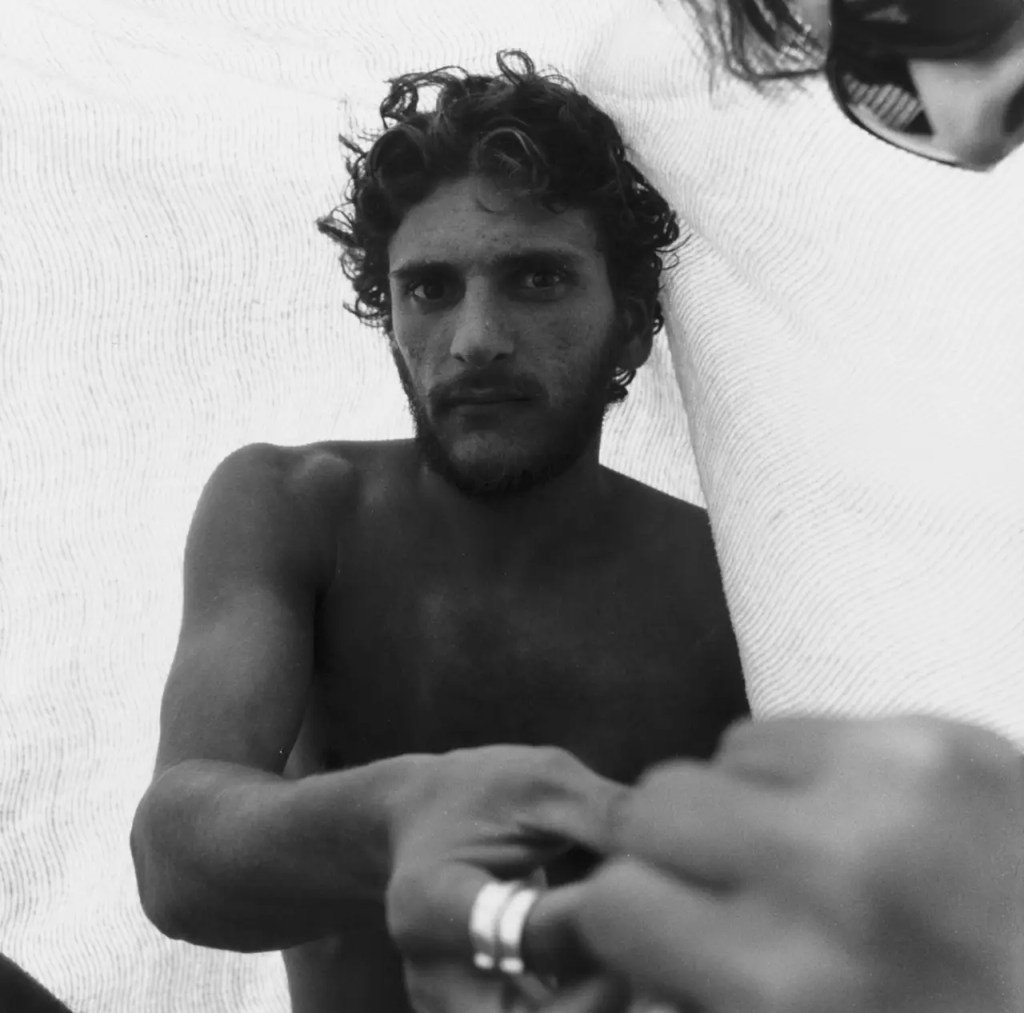
With this expansive exhibition, LUMA Arles pays tribute to David Armstrong’s distinctive vision and his lasting impact on contemporary photography. The presentation, brilliantly curated by Matthieu Humery, offers a glimpse into the work of an artist who captured simple moments of friendship, love and insouciance.
Featuring portraits of Nan Goldin, Klaus Biesenbach, David Wojnarowicz, and Cookie Mueller among others, this major new exhibition traces the avant-garde circles that defined New York and Boston in the 1970s. Not as dark as Nan Goldin’s depictions (who is also featured in this year’s Rencontres d’Arles), and not as theatrically-staged as Peter Hujar’s work, David Armstrong’s work oscillates between melancholy and apparent joy.
Armstrong captured the places he encountered along the winding course of his life (he died in 2014), offering a vision that feels both distant and frozen in time. Taken in the late 1980s, at the height of the AIDS epidemic or just before, these images resonate through the lens of that tragedy, reminding viewers of life’s transience.
It was Nan Goldin, curator of the 2009 Rencontres d’Arles, who first introduced David Armstrong’s work to audiences visiting this iconic photography festival in the historic city of Arles, in the South of France. Years later, his work returns to Arles with this new exhibition. More than a portraitist, Armstrong, who passed away in 2014, captured the spirit of a generation and a distinct stance toward life, crystallized in images that are at once intimate and arresting. From the outset of his career, he set out to document his era and the friends, lovers, and cultural figures who defined it.
During the 1970s, Armstrong studied photography at the School of the Museum of Fine Arts, where he became connected to a broader circle of avant-garde artists including Philip-Lorca diCorcia, Mark Morrisroe, and Jack Pierson, among others. The “Boston School” was formed. His first black-and-white images portray a generation of youth that is at once contemplative and rebellious, conveying both total freedom and fragility.
The exhibition is curated in a smaller space than other exhibitions presented at LUMA before, including the spectacular 2023 Diane Arbus show. This works very well, and brings new perspectives to the shows featured in the spectacular venue of LUMA. The display is featured across two large rooms, one dedicated to Armstrong’s framed vintage prints and beautiful vitrines with contact sheets. The second room is devoted to works in colour, rotating on screens. The dichotomy between black and white and colour, works perfectly in these geometric spaces.
This must-see exhibition remains on view in Arles until 5th October at the fantastic LUMA Foundation.
–
Image: David Armstrong. “Johnny,” Provincetown, late 1970s. Courtesy of the David Armstrong Estate.
 ART IS ALIVE