The French capital remains an endless source of beauty, with its world-class museums, unforgettable cuisine, cinematic streetscapes, small urban gardens, and monuments etched into the global consciousness.
Paris is experiencing an artistic renaissance, fuelled by the expansion of Art Basel at the Grand Palais and standout exhibitions like David Hockney’s retrospective at the Louis Vuitton Foundation and Céleste Boursier-Mougenot’s “Clinamen” installation at the Bourse de Commerce, among many others on view this Summer. This vibrant convergence of major events and showcases firmly reestablishes Paris as a hub for contemporary art, drawing artists, collectors, and enthusiasts from across the globe.
The Champs-Élysées has been hailed as the most elegant avenue in the world, and with good reason. This grand ‘transverse’ connects two of Paris’s architectural treasures: the majestic Place de la Concorde and the iconic Arc de Triomphe. A constellation of important landmarks are there too, including the luminous Grand Palais which recently reopened following restoration and hosts Art Basel, its charming ‘counterpart’ the Petit Palais, and the majestic Palais de la Découverte.
The Arc de Triomphe is one of Paris’s most iconic monuments, located at the western end of the Champs-Élysées at Place Charles de Gaulle. It was wrapped by artist Christo in 2021. Commissioned in 1806 and inspired by Rome’s Arch of Titus, it was designed by Jean Chalgrin to honour those who fought for France during the French Revolutionary and Napoleonic Wars. The names of French victories and generals are inscribed on its surfaces, and beneath it, lies the Tomb of the Unknown Soldier from World War I.
From Arc de Triomphe, twelve avenues converge forming an impressive ‘star’. One of these avenues is Avenue Mac-Mahon. It hosts the beautiful and new Miss Fuller Hotel at number 11.
Nestled behind its magnificent ashlar façade, designed in 1894 by the renowned architect Louis Arthur Marnez (1856–1950), Miss Fuller conceals a fantastic world where artistry meets comfort and luxury.
In 2021, shortly after the future Miss Fuller changed hands, the new owner handed over the keys to the Drawing Society to temporarily inhabit the space during its design phase. At the initiative of Christine Phal and Carine Tissot, President of Drawing Hotels Collection, Drawing Society, and Executive Director of Drawing Now Paris, and with the support of the Centre National des Arts Plastiques (Cnap), 33 contemporary drawing artists were invited to take up residence, transforming the hotel’s rooms into ephemeral studios.
Carine talks to Art is Alive: “Miss Fuller is the latest hotel from the Drawing Hotels Collection and it reflects our mission: to embed contemporary art, especially drawing, into the very structure of hospitality. But here, we went even further. Before renovation, the building hosted the Drawing Factory, a temporary creative hub where 30 artists were invited to inhabit the space and create in total freedom. From this vibrant residency, five artists were selected to produce permanent, site-specific works for the newly designed hotel.” Everything came full circle in this stunning hotel.
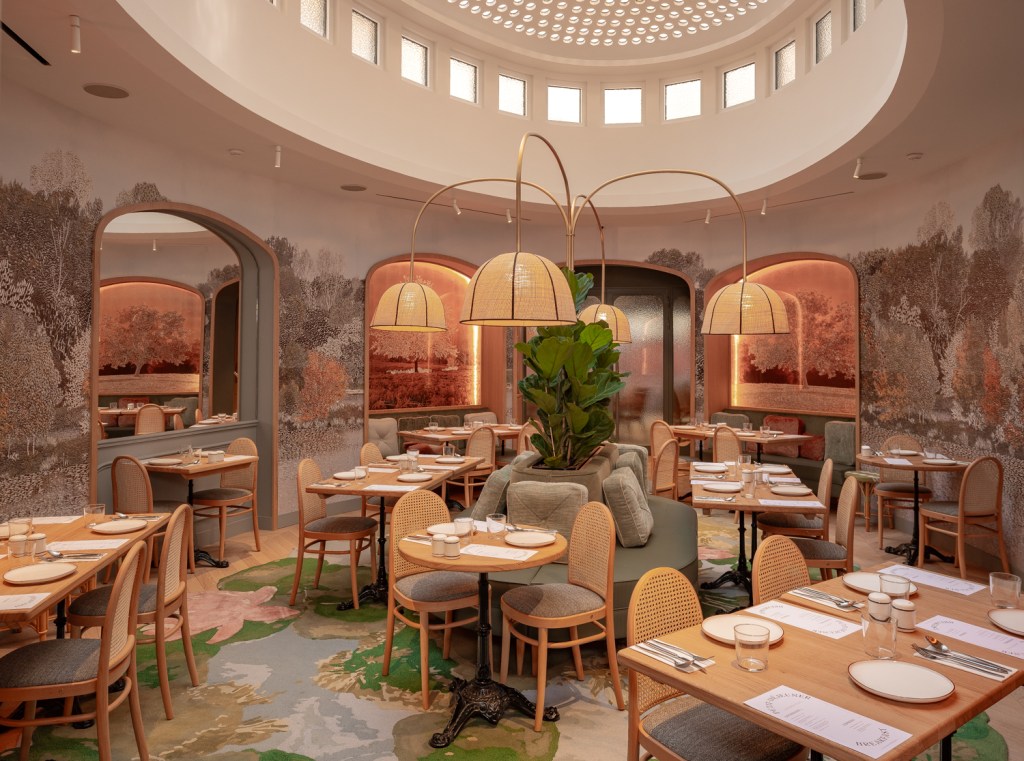
The character of Miss Fuller comes from its unique design. “We collaborated directly with the five artists selected during the Drawing Factory. Four of them, Camille Chastang, Camille Fisher, Fabrice Cazenave, and Chloé Dugit-Gros, created bespoke wallpapers and carpet designs for each floor, turning every corridor into a visual landscape. Raphaëlle Peria, the fifth artist, designed an immersive installation at the heart of the hotel and in its restaurant, Le Serpentine. Each contribution enriches the guest experience, art is not simply decoration here, it’s part of the architecture.”
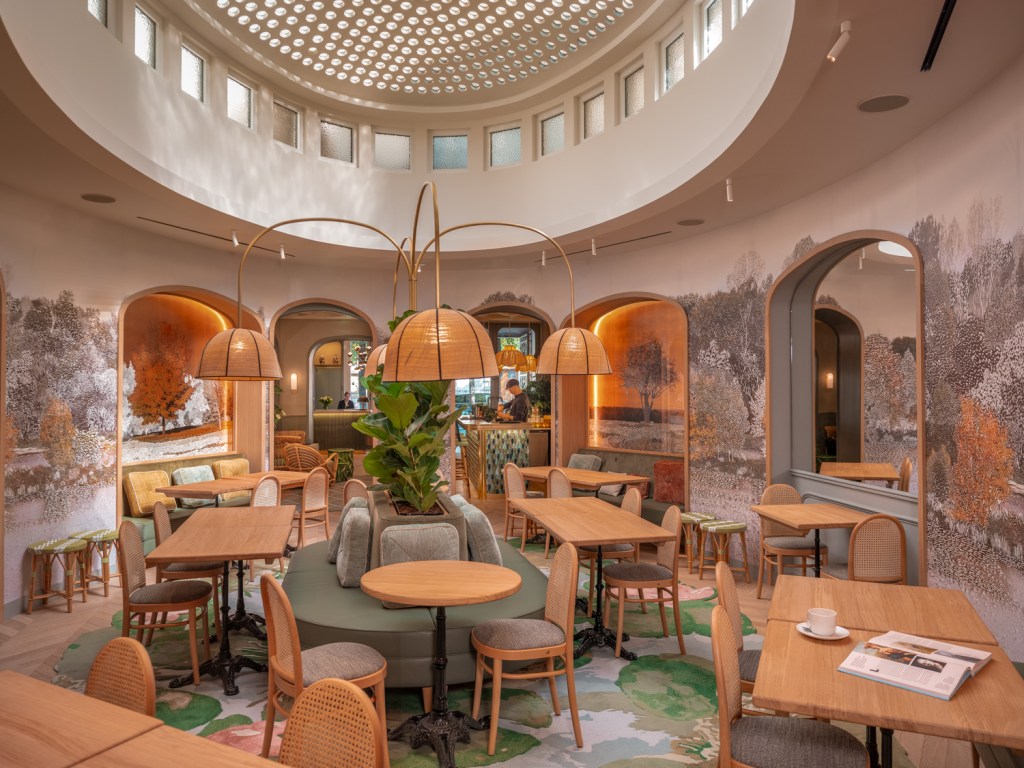
In her work, Raphaëlle Peria invites guest to embark on a journey aboard an imagery boat, where viewers can quietly observe the ever-changing panorama of nature and its trees through the seasons. From the tender buds of spring to the lush abundance of summer, from the rich, warm hues of autumn to the quiet, snow-dusted stillness of winter, nature unfolds as a breathtaking spectacle.
The overall concept of the hotel draws inspiration from Art Nouveau, a movement that redefined form and ornament, much like we aim to redefine the hotel experience.” Think the cities of Vienna, Nancy and Barcelona with its curved and nature-inspired buildings, stained glass windows, sculptures and public furniture. Key figures of the Art Nouveau movement include Hector Guimard, known for his iconic Paris Métro entrances; Antoni Gaudí, whose visionary architecture shaped Barcelona’s Sagrada Família; and Gustav Klimt, a central figure in the Viennese Secession.
Art Nouveau had a profound impact on the decorative arts, spanning furniture, jewellery, and glasswork, with artists such as René Lalique and Émile Gallé pushing the boundaries of craftsmanship. Though relatively short-lived, the movement left an indelible mark on design history, laying the groundwork for Art Deco and the emergence of modernism in the 20th century. Reflecting this movement: “Miss Fuller is not only a place to stay, it is a place to live with art.” Carine continues.
Upon arrival, the main outside space showcases two huge armchairs inviting for relaxation when waiting for a friend or a taxi. Behind these two pieces of furniture a beautiful ornate stained glass artwork welcomes guests. This is a masterpiece by artist Jacques Gruber (1870–1936), depicting the sign of Aquarius. The work signals the beginning of a journey through time.
“The building stands in a district that bridges tradition and modernity, perfectly suited to the Art Nouveau revival we envisioned. We imagined the hotel as inhabited by a fictional yet iconic muse, Loïe Fuller, the legendary dancer whose swirling silk performances enchanted artists like Rodin, Toulouse-Lautrec, and the Lumière brothers.”
Loïe Fuller, born on 15 January 1862 in Fullersburg, Illinois, was an American dancer and choreographer celebrated for her groundbreaking artistic innovations. After an early career in theatre in the United States, she shifted her focus to dance and relocated to Paris in 1892, where she achieved immediate acclaim. A true pioneer of modern dance, Fuller captivated audiences at the Folies Bergère with her mesmerising serpentine performances which gives its name to the restaurant of the hotel. Through a visionary mix of flowing silks and experimental lighting, she created hypnotic, undulating forms that felt ethereal. Her work placed her at the heart of the Parisian avant-garde during the Belle Époque, and she became an emblematic figure of the Art Nouveau movement, known for its sinuous lines and natural motifs.
“Loïe Fuller symbolises fluidity, light, and the avant-garde spirit of her time. Her presence resonates throughout the building, as a whisper, a movement, an energy. The hotel is her echo, in drawing, light, and emotion.” Some of her movements were captured on camera and can still be viewed today.
Did the teams work with an architect and interior designer? “We worked closely with NIDO Architecture, an interior design studio that shares our commitment to blending artistic vision with functionality. Together, we developed a space that is both elegant and narrative.” Carine adds.
Alexandra Bernaudin and Chiara Patrassi, founding partners of NIDO, place great emphasis on artisanal craftsmanship, bespoke design, and ethical practices, all in pursuit of creating interiors that are not only unique and refined, but also serene and deeply harmonious. Their projects include residential, commercial and hospitality spaces.
Bathed in natural light, the ground floor of Miss Fuller is crowned by a magnificent basket-shaped glass roof, the centrepiece of the hotel, drawing light from the hotel’s inner courtyard and its lushly planted patio where the excellent breakfast is served. Here, the architecture is elevated, its curves accentuated, and the atmosphere imbued with an effortless sense of warmth. Every element, from the furniture to the crockery, carpets to textiles, exists in graceful harmony with the soft, natural palette that defines the space. It’s bijou and absolutely gorgeous.
“The art collection at Miss Fuller was not curated after the fact, it was imagined and created before the hotel was even renovated. This collection is a true collaboration between artists and architects, a living testament to our belief that drawing belongs in life, not just in museums. It’s what the Drawing Society was founded to support.”
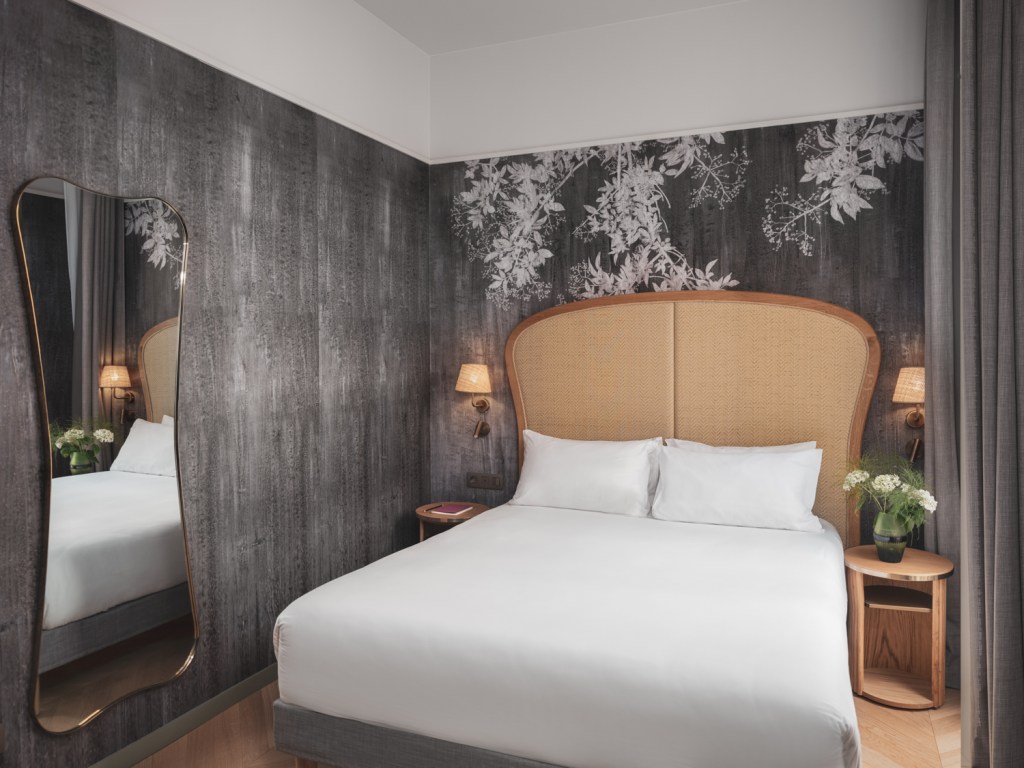
Miss Fuller offers 48 individually designed rooms, each crafted as an intimate work of art blending comfort and modern luxury. All rooms feature thick bathrobes, slippers, and towels, nice Rituals toiletry products, coffee machines, TV screens and branded notepads.
“Our guests are culturally curious. Many are collectors, artists, designers, or simply art lovers. Some come because they know our history through Drawing Now Paris, our contemporary drawing fair; others discover us through word of mouth, and return because they’ve found something different, something personal. Locally, we’ve built a community as well: through our exhibitions, artist talks and collaborations with institutions such as the École des Beaux-Arts, Drawing Lab Paris, the Fondation Pernod Ricard, and the Fondation Cartier. Guests are often surprised by how naturally they engage with the artworks around them, and that’s precisely what we aim for.” That’s again the beauty of Paris’ rich cultural landscape, exhibitions at every corner.
Each of the hotel’s five floors has been transformed by a different contemporary artist, turning the fantastic rooms into tasteful environments, some with stunning views over Arc de Triomphe itself.
• 1st Floor – Camille Chastang contrasted monochrome corridors adorned with handmade cameos and vibrant rooms filled with floral patterns inspired by period wallpaper and Loïe Fuller’s costumes.
• 2nd Floor – Fabrice Cazenave created a calming, dreamlike atmosphere with corridor walls resembling night skies and graphite-covered rooms featuring delicate drawings of verbena and chamomile, revealed by erasure.
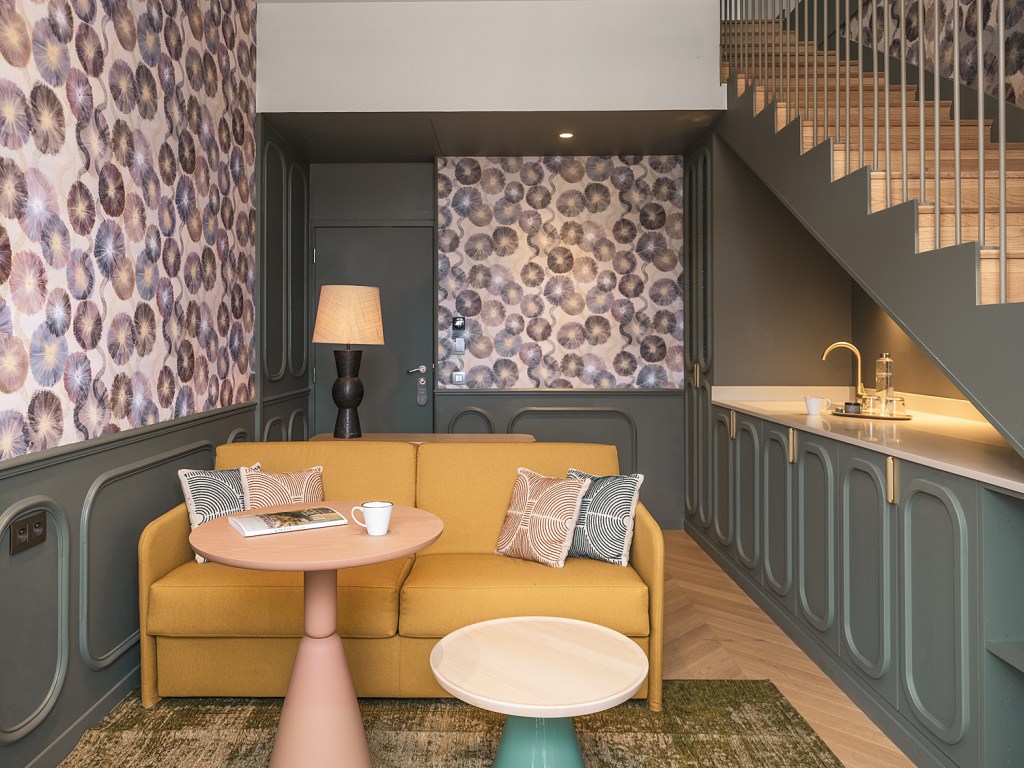
• 3rd Floor – Chloé Dugit-Gros explored the relationship between pattern and design through Art Nouveau-inspired forms, with flowing motifs across carpets and walls that invite close observation.
• 4th Floor – Camille Fischer played with transparency, showing both sides of her drawings. The rooms are lush and exotic, with natural imagery climbing the walls and ceiling.
• 5th Floor hosts four artist-designed duplex suites with panoramic views of Paris, each offering a unique and elevated artistic experience.
“The hotel has the soul of a drawing: intuitive, expressive, and full of movement. Miss Fuller isn’t defined by trends either, it’s defined by gesture and intention. There’s a quiet intensity to the space, born from the works of artists who left their mark in every corner. You can feel the presence of Loïe Fuller, yes, but also the energy of those who created here. It’s an atmosphere that encourages you to reflect, dream, and look more closely. Above all, it’s a place of generosity and transmission, which is exactly what the Drawing Society stands for.”
Art, comfort, design, the strategic location all intertwine. “The art gives the hotel its identity, but it doesn’t come at the expense of comfort, it enhances it. The design is thoughtful, not ostentatious, and the location offers both calm and proximity to Paris’s landmarks. But perhaps the real asset is the feeling of being inside a story. Not a themed hotel, but a place with a pulse, where everything from the lighting to the artwork to the breakfast playlist is curated with intent.”
Miss Fuller has seen several editorial shoots taking place, particularly those looking for a rich, textured setting. The combination of Art Nouveau references and contemporary artwork provides a very distinctive backdrop.
As for artists: “Many of those who took part in the Drawing Factory residency stayed on-site, and we continue to host artists during cultural events or art fair seasons. Some have gone on to exhibit internationally.” Celebrities? “A few, yes, but we tend to keep things discreet. What matters is that everyone, famous or not, feels the same sense of welcome and inspiration.”
Each room at Miss Fuller features meticulously curated furniture, rich in references to the great masters of Art Nouveau. Curved metalwork, echoing the sinuous lines of Hector Guimard (1867–1942), shapes the scrolls of the table legs, while a striking glass partition, mirroring these same flowing forms, conceals a wardrobe and leads to the bathroom.
Natural wood brings warmth to the bedside tables and the sculptural headboard, wrapped in leather and subtly evoking the craftsmanship of cabinetmaker Louis Majorelle (1859–1926). Over the table hangs a fringed, coloured glass pendant, a delicate homage to Émile Gallé (1846–1904), complemented by light fittings throughout the room that reflect his influence. Console tables in the room recalls the organic curves favoured by goldsmith René Lalique (1860–1945), while woven rattan chairs reference the enduring appeal of this sustainable material, celebrated since the 19th century. So many amazing references throughout the space.
What’s the best way to come to the hotel? “I always recommend arriving on foot if you can, those last few minutes set the rhythm of your stay.”
Carine talks about her challenges too: “Balancing the creative freedom of artists with the practical demands of hotel operations is a delicate dance. We want our guests to feel immersed in art, but also deeply comfortable and cared for.
Being both President of the Drawing Hotels Collection and Executive Director of Drawing Now Paris, I’m constantly bridging two worlds: the artistic and the operational. But that’s where the challenge becomes a strength, we know how to speak to both artists and travellers.”
11 avenue Mac-Mahon has become a true address for artists, a vibrant meeting point for contemporary creation. One can easily imagine Miss Fuller herself feeling perfectly at home here, immersed in the very heart of artistic expression.
Facing new climate challenges, hotels also have to adapt and find solutions. What are the Green initiatives to protect the planet? “Sustainability is not a marketing slogan for us, it’s integrated into every stage of our process. We used durable, low-impact materials, prioritised French or European suppliers, and minimised waste throughout the renovation. The Drawing Factory also embraced circularity, many of the installations repurposed existing elements of the building. We continue to reduce energy consumption, encourage responsible sourcing, and partner with local and eco-conscious brands whenever possible.”
From mid-September, the restaurant Le Serpentine, already open for lunch and weekend brunch, will also be open in the evenings from Tuesday to Saturday. It will surely continue to be a hot spot! In addition, Miss Fuller offers bespoke private dinners for up to 20 guests. Executive Chef Aurélien Debrenne prepares a tailor-made menu to enjoy a truly shared experience.
Open daily, the Miss Fuller bar invites guests to discover a unique cocktail menu crafted by the house Mixologist. Each creation is inspired by the works of the guest artists, transforming every drink into a sensory extension of their artistic universe. The space is charming and the cocktails are delicious.
Last but not least, Miss Fuller features a wellness space. For pure relaxation, massage (by appointment) are available. It is also possible to unwind in the spa’s private soaking bath. For more physical activities, the 24-hour gym is also amazing with a glorious view over a small terrace.
What are Carine’s top suggestions for cultural discoveries in Paris? “Start with Drawing Lab Paris, our independent art centre fully dedicated to contemporary drawing. Then head to Fondation Pernod Ricard or Lafayette Anticipations for bold contemporary programming, and of course the Bourse de Commerce for major international exhibitions.
If you’re looking for more intimate experiences, I highly recommend the Musée Bourdelle, an unexpected haven of sculpture and history in the heart of Montparnasse.
And from October, don’t miss the reopening of Fondation Cartier, just steps away from the Drawing Hotel, our very first signature property located on Rue de Richelieu. It’s an exciting new chapter for the Parisian art scene.”
The Drawing Hotels Collection, led by Florian Bitker, manages both its own properties and those of investors seeking to combine the rigour of hotel expertise with the distinctive spirit of contemporary artists. For Carine, a hotel without art is simply unimaginable. Each of the group’s properties is conceived, designed, and brought to life in close collaboration with artists and designers, ensuring that creativity is woven into every aspect of the guest experience.
Her hidden gem in Paris? “I’m not sure it’s exactly hidden, but I’d say Rue Chapon, in the Marais. It has become a vibrant street for contemporary art, with many galleries choosing it as their home. There’s also a string of charming cafés that make it perfect for a weekend stroll.
You’ll often find me there on Saturdays, it’s where I reconnect with the city and discover what’s next in the art world.”
With its Art Nouveau inspiration, meticulous attention to detail including its beautiful logo, refined décor, and outstanding service, Miss Fuller Hotel stands out as one of Paris’s most exceptional addresses.
Ideally located with easy access to major museums and cultural landmarks, it offers a haven for art lovers and curious travellers alike.
In a city pulsing with energy, Miss Fuller Hotel brings a fresh breeze of artistic inspiration, beautiful materials, and innovation to the Parisian hospitality scene. It’s currently the best new hotel in Paris!
–






Thank you Carine Tissot and Alice Wiet.
 ART IS ALIVE