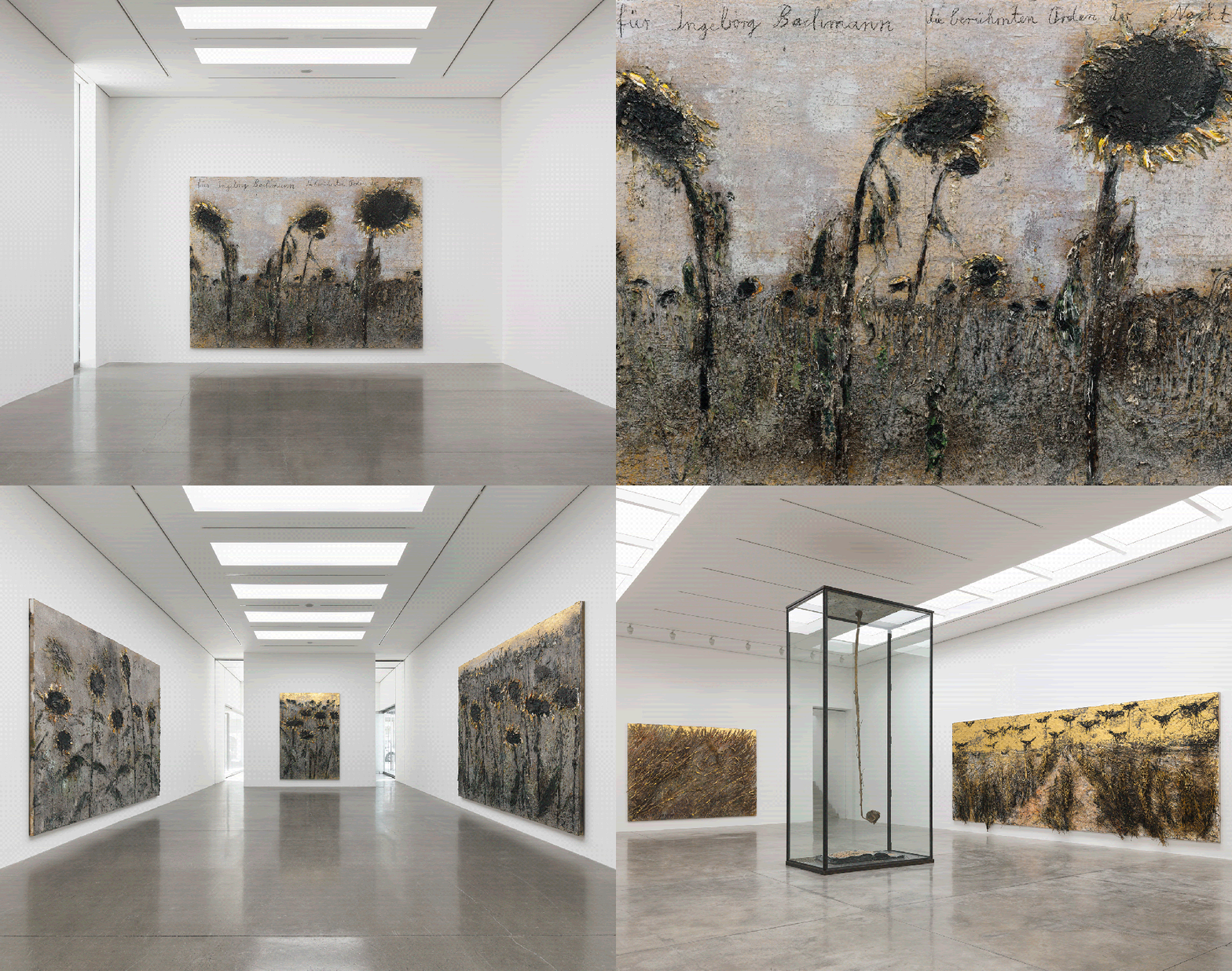
In this presentation of recent works at White Cube Mason’s Yard, running until August 2025 in London, Anselm Kiefer revisits an artistic connection rooted in his youth, paying tribute to the landscapes of Vincent van Gogh. Although separated by more than a century, Kiefer, like Van Gogh, treats the landscape as a profound site of artistic and philosophical subject matter.
Kiefer’s connection to the Dutch master dates back to a formative journey he undertook in 1963, at the age of 18, retracing Van Gogh’s path across Europe—from the Netherlands and Belgium to Paris, and ultimately to Arles, where Van Gogh produced many of his most iconic works in the final years of his life. These are the very paintings Kiefer reimagines through his own visionary lens. In the works on view at Mason’s Yard, striking parallels emerge between the two artists: a shared belief in the landscape as a site of existential reflection and emotional depth, and a mutual dedication to a richly tactile, expressive use of paint. Rather than collapsing their differences, these affinities underscore the unique sensibilities that define each artist’s approach.
Engaging with a motif closely tied to Van Gogh’s Arles period, Kiefer’s series of sunflower paintings, displayed in the ground floor gallery, offers a contemplative reinterpretation of the subject. Forgoing Van Gogh’s vivid yellows, Kiefer renders his sunflowers in thick impasto, using ashen greys and scorched earth tones to imbue the works with a somber, elegiac mood.
Kiefer’s sunflowers, their heavy heads bowed earthward, seem burdened by the weight of longing. And yet, they endure, rising from the soil with a haunting, almost human presence, reaching toward skies that are at once darkened and luminous. One painting includes a line from William Blake’s 1794 poem Ah! Sun-flower, in which the flower, weary and yearning, dreams of a “sweet golden clime” that fades with each setting sun.
In his series of wheat field paintings, Kiefer embraces Van Gogh’s palette with greater fidelity, rendering terrains of radiant gold that exude the ripeness of harvest. In Van Gogh’s fields – where the golden crop, tilled by reaper-labourers, came to embody nature’s inexorable cycles and the transience of life – Kiefer discerns the symbolic potency of yellow and the paradoxes it encodes. In his own vision, he draws out its dual valence: vitality, joy and hope, but also duplicity, malaise and decay – a dualism that, through his incorporation of gold leaf, accrues a sacred resonance.
 ART IS ALIVE