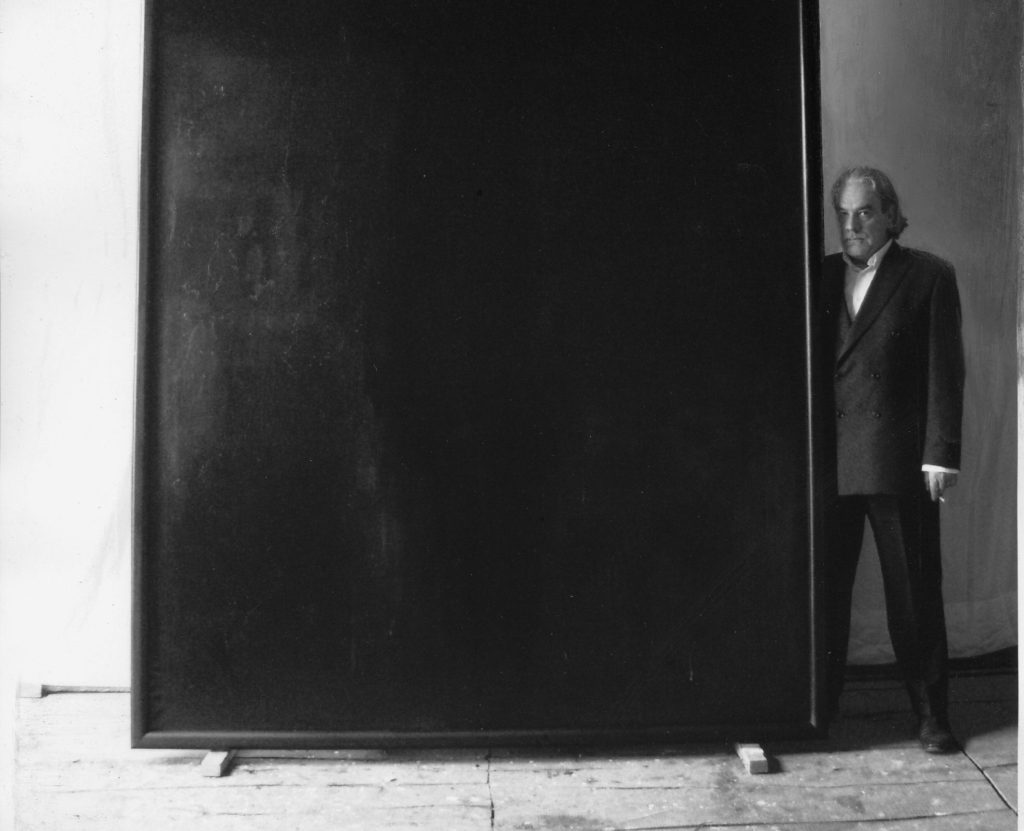
Fondazione Prada presents NADA, a site-specific monographic exhibition by Belgian artist Thierry De Cordier, specially conceived for the three-part Cisterna building at its Milan venue. Running from April 3 to September 29, 2025, the exhibition features ten large-scale paintings from the NADA series, created between 1999 and 2025.
The series began with the artist’s deliberate act of erasing the crucifixion image. Over time, these works evolved beyond negative painting, becoming a profound exploration of what De Cordier describes as the “grandeur of nothingness.”
As De Cordier recalls, “My first black painting (now destroyed) is the result of an intention: to abolish the image of Christ on the Cross, albeit in a demonstrative way. At no point did I think about making a great painting. My sole objective was to symbolically annihilate a deeply rooted Christian image. That was all it was about at the time. Then one day, while immersed in a biography of the Spanish mystic Saint John of the Cross, I happened upon the following passage: ‘No emphasis, but absolute rigor. The search for the NADA (Nothing) of the Cross; the concern for the only thing necessary…’ Suddenly, a vision arose within me, significantly deepening the mean¬ing of these paintings, by freeing them from the restrictive interpretation in which they were trapped. As they were freed from the original negation (which had prompted me to paint them), they gradually evolved towards the ultimate achievement in painting, i.e. the sublime.”
Thierry De Cordier’s ten canvases are almost monochromatic but cannot only be interpreted as purely abstract or conceptual works. As the series’ title suggests, they constitute a black pictorial space that opens onto nothingness. NADA is also the inscription that appears in some paintings in the position of the historical acronym INRI (Iesus Nazarenus Rex Iudaeorum), which, according to the Gospels, was affixed to the Cross of Christ and represented by many artists in their depictions of the crucifixion.
Showcasing this group of ten works from the NADA series in the Cisterna building is a deliberate decision. Comprising three exhibition rooms that extend vertically and illuminated by light that filters through large windows in the buildings’ top section, this post-industrial architecture evokes an ecclesial or sacred space in terms of size and conformation. De Cordier’s design, with a structure in each room, creates the impression of a monumental triptych with the side doors open. The large paintings are hung in the center of the long side of these structures, while the lateral modules also have niches on the shorter sides to display smaller works. A bench in front of his colossal canvas Gran Nada (2007-2012), located in the central room of the Cisterna, serves as a point of observation and contemplation, marking the fulcrum of the entire installation.
 ART IS ALIVE