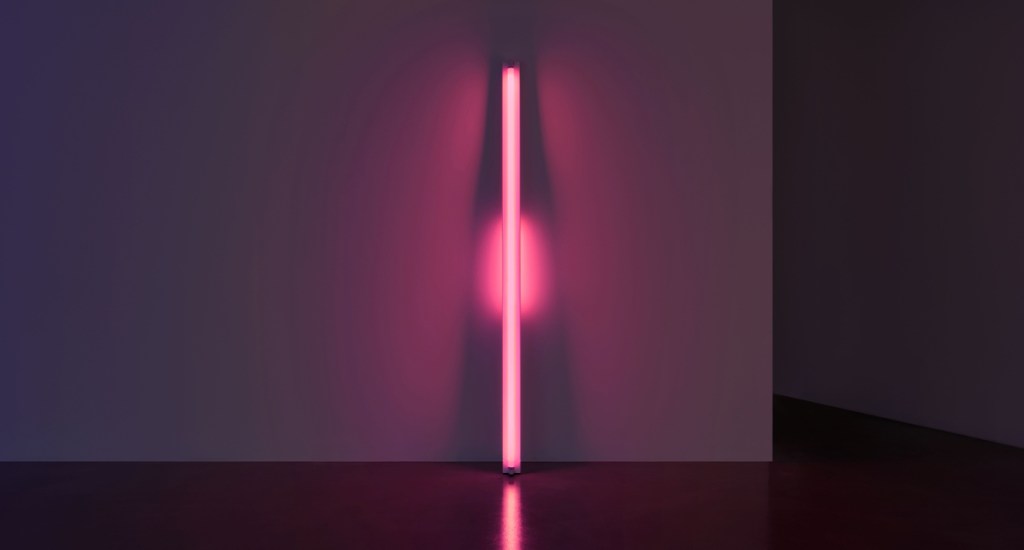
Dan Flavin (1933-1996), one of the leading artists exploring light and space is honoured by Ordovas in London in an exhibition opening today.
The gallery is entirely dedicated to four major “situations” that define Flavin’s career, highlighting his significance and influence within the canon of Post-War art.
The exhibition showcases works from the 1960s, 1970s, and 1980s, including a key installation from 1963—a pivotal year when Flavin first incorporated his signature fluorescent light tubes. By transforming an everyday object into a work of art (à la Duchamp), he explored how light shapes and defines space.
Through relentless experimentation, Flavin learned how to masterfully manipulate the limited number of combinations proposed by his standardised light fixtures. In the 1970s and 1980s, he began to create more ambitious and elaborate compositions including large barriers, corridors, and corner installations. He spent much of his later career designing large-scale architectural interventions including at both Grand Central Station and the Solomon R. Guggenheim Museum in New York, and Donald Judd’s Chinati Foundation in Marfa, Texas – the last completed posthumously. In 1983 he designed the Dan Flavin Art Institute in a converted firehouse in Bridgehampton, New York, now managed by the Dia Art Foundation.
Image: Dan Flavin installation view, Photography by Stuart Burford
 ART IS ALIVE