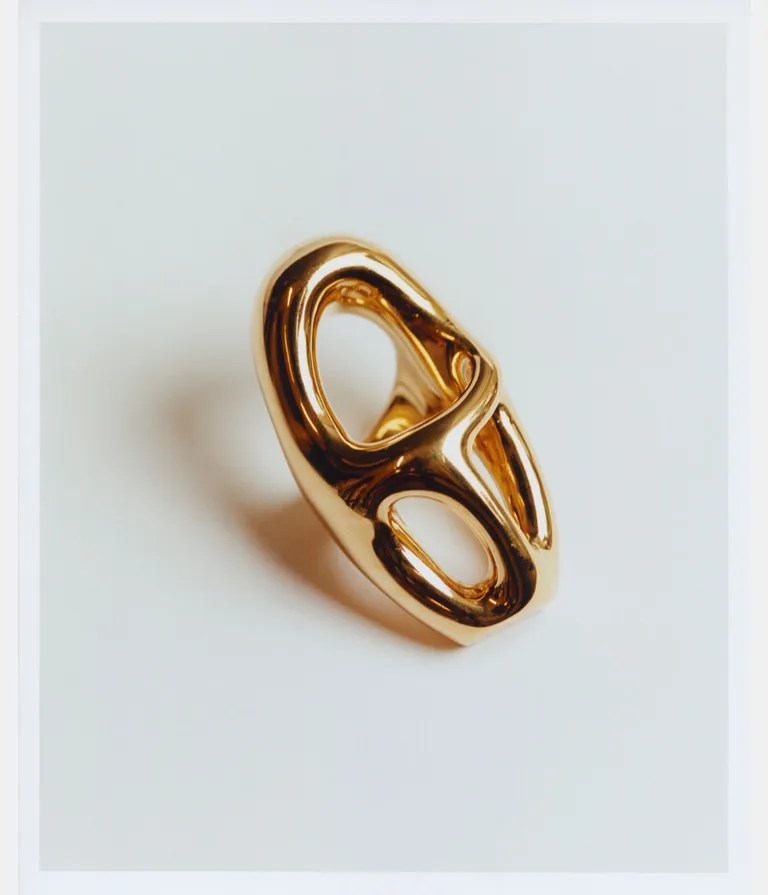
Forms were an abstract concept for German-French artist Jean Arp, who drew on nature’s organic shapes to create flowing, sensuous forms. Inspired by his ephemeral sculptures, particularly those from the 1950s shaped during his Greek travels, ex-Celine creative director Hedi Slimane selected Arp’s work as the focus for the third iteration of the Celine Bijoux d’Artistes Project.
This initiative, which honours avant-garde artists, previously reinterpreted works by César and Louise Nevelson into wearable art in 2020 and 2022. Now, it pays homage to Arp’s Ptolémée II, a biomorphic sculpture balancing void and solidity, form and space.
‘Arp’s Ptolemy sculptures, created in his Meudon-Clamart studio, epitomise the harmony between fullness and emptiness,’ says Etienne Robial, president of Fondation Arp, who collaborated with Celine on the project. Located just outside Paris, the Fondation Arp serves as a meticulously preserved tribute to Jean Arp and Sophie Taeuber-Arp. The house-studio and gardens remain a hub for artists, researchers, museum curators, and exhibition commissioners. With its well-maintained grounds and carefully curated interiors, the Fondation embodies the Dadaist philosophy that shaped the couple’s life and work.
For Robial, the collaboration with Celine represents a seamless fusion of Arp’s philosophy, Celine’s aesthetic, his own creative practice, and the contemporary cultural landscape. ‘What draws me to Arp is the interplay between form and counter-form, a theme closely connected to my work as a graphic designer and typographer. An Arp sculpture, to me, is akin to a letter in the alphabet. As president of the Fondation Arp, my focus is on exploring the parallels between the works of Jean Arp and Sophie Taeuber-Arp and today’s artistic discourse.’
–
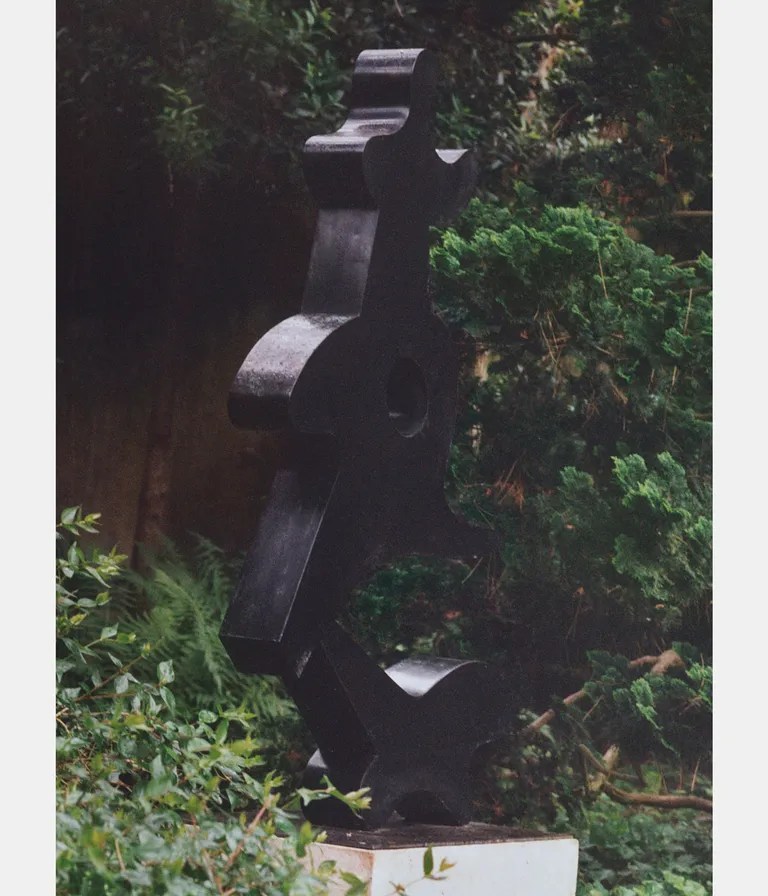
Image: Vermeil pendant, from the Jean Arp Celine Bijoux d’Artistes Project, by Celine, (Image credit: Jean-Marie Binet) and Apparat d’une danse (Dance finery in motion), 1960, by Jean Arp, (Image credit: Jean-Marie Binet).
 ART IS ALIVE