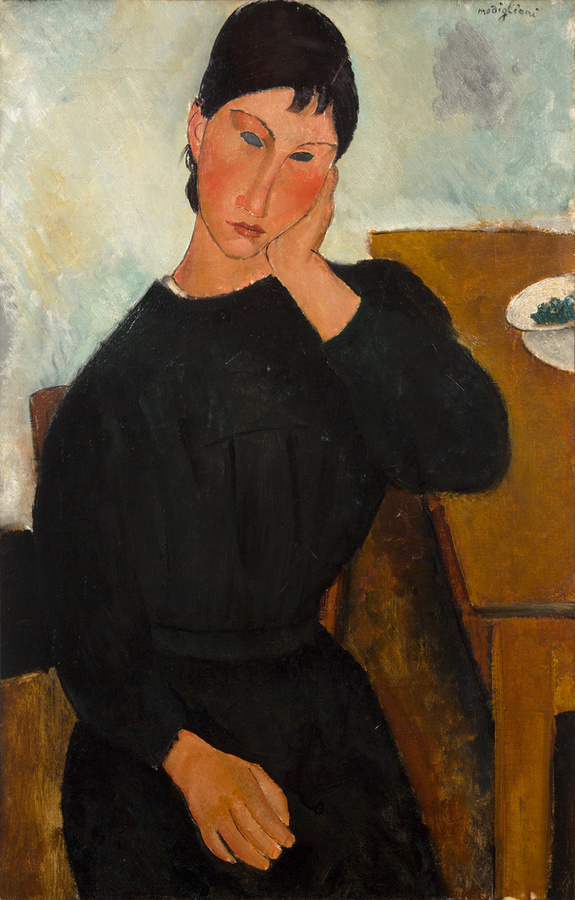
Running until 15th January 2024, Amedeo Modigliani and his dealer is presented at Musée de l’Orangerie in Paris. The exhibition addresses investigates the connections between the painter and his dealer within the Parisian literary and artistic milieux of the 1910s, as well as Paul Guillaume’s part in the propagation of Modigliani’s work within the French and American art markets of the 1920s.
This show seeks to retrace one of the most significant events in Amedeo Modigliani’s life—the time when Paul Guillaume became his dealer—nearly a century after the two men first crossed paths in 1914. It centres on examining how the two characters’ connections might shed light on the artist’s background.
The poet Max Jacob (1876–1944) might have introduced young Paul Guillaume, a collector and gallery owner, to Modigliani in 1914. The correspondence between Paul Guillaume and his tutor, the poet and art critic Guillaume Apollinaire (1880–1918), who was present at the Front, suggests that he then likely became his dealer.
The merchant would have been in possession of almost a hundred canvases, fifty sketches, and twelve sculptures by Modigliani in addition to the five paintings that are presently on display at the Musée de l’Orangerie. These figures show the degree of the gallery owner’s support for the artist’s career as well as his own preference for the artist’s paintings, which adorn the walls of many of his apartments. Portraits of important Parisian figures of the era, such as Max Jacob, André Rouveyre, Jean Cocteau, and Moïse Kisling, are among them. There are also portraits of unidentified models and some exquisite sets of portraits of the women who were in the painter’s life, starting with Béatrice Hastings and continuing with the young painter Jeanne Hébuterne, his final friend and mother.
–
Image: Amedeo Modigliani (1884-1920), Elvire assise, accoudée à une table, 1919, Saint-Louis, Saint Louis Art Museum, don de Joseph Pulitzer Jr. en mémoire de sa femme, Louise Vauclain Pulitzer, 77:1968/ Image Courtesy of the Saint Louis Art Museum
 ART IS ALIVE