The Deutsche Börse Photography Foundation rewards artists and projects considered to have made the most significant contribution to photography over the previous 12 months. Over its 27-year history, the Prize has become renowned as one of the most important awards for photographers as well as a barometer of photographic development, platforming pioneering work.
Bringing together the work of the four international shortlisted artists, The Photographers Gallery in London stages an incredible show. Bieke Depoorter, Samuel Fosso, Arthur Jafa and Frida Orupabo are celebrated across an exhibition running until 11 June 2023.
Drawing upon the West African tradition of studio portraiture, Samuel Fosso creates startling new identities through self-portraiture, based on social archetypes as well as real historical figures.
Arthur Jafa uncompromisingly articulates Black experience, providing us with an exercise in visual literacy, confronting us with a new Black aesthetic which avoids fixed hierarchies and linear storytelling.
Bieke Depoorter explores the complex ethical relationship and boundaries between photographer and subject, shown through the intense scrutiny of her relationship with her own subjects, Michael and Agata.
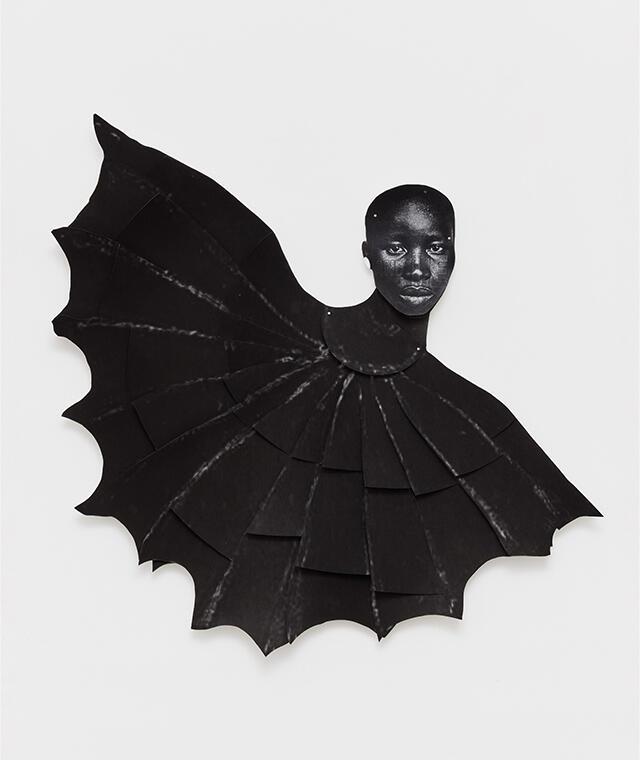
Giving sculptural form to photo collage, Frida Orupabo reimagines the historical Black female body through her extraordinary multi-layered collages and Instagram posts using material circulated online. The artist creates spectacular photographic collages that take the shape of fragmented, Black, mostly female-bodied figures, exploring questions of race, sexuality and identity. Orupabo, a Norwegian Nigerian artist and sociologist, grounds her inquiry in her own experience of cultural belonging.
Orupabo’s source material is drawn from digitised colonial archives, social media platforms and online marketplaces. A process that begins online is resolved by hand as she lays one printed image segment on top of another. This reassembling layer by layer is a complex and poetic manoeuvre that simultaneously denounces one-dimensional depictions of Black lives.
Orupabo began posting on Instagram as @nemiepeba in 2013. The platform functioned for her as a personal archive, an expressive outlet and an ordering system. Her collaged cut-outs hold our gaze and invite various readings of the stories and lives of the people depicted, many of whom are entirely absent from the archives. In this way Orupabo invites a consideration of how photography significantly contributes to the formation and perpetuation of colonial power relations and violence.
 ART IS ALIVE