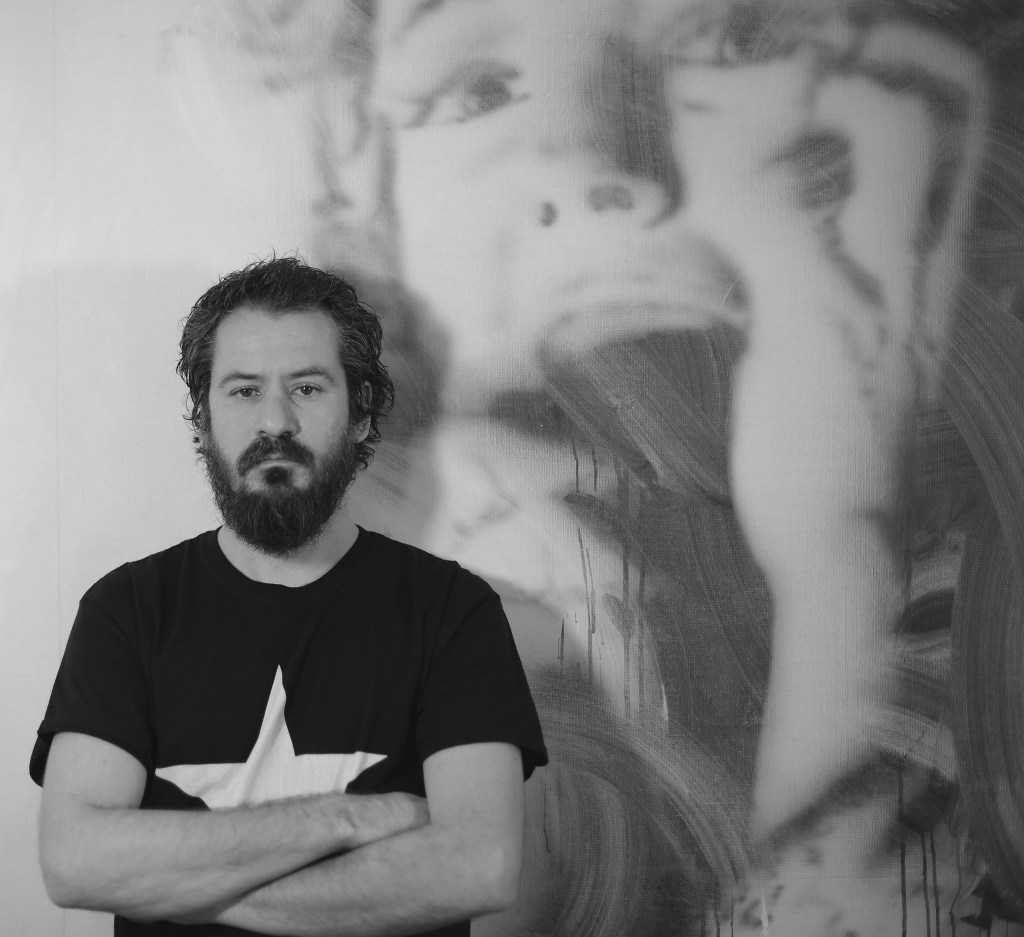
Reconstruction, History, Humanism, and the sublime are some of the key themes explored in Mircea Suciu’s majestic work.
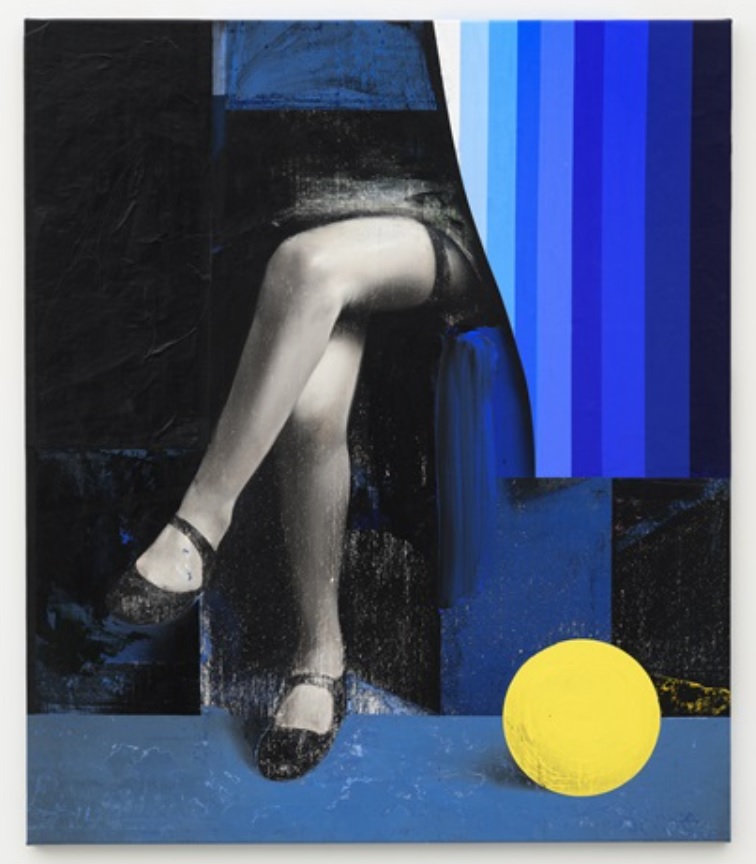
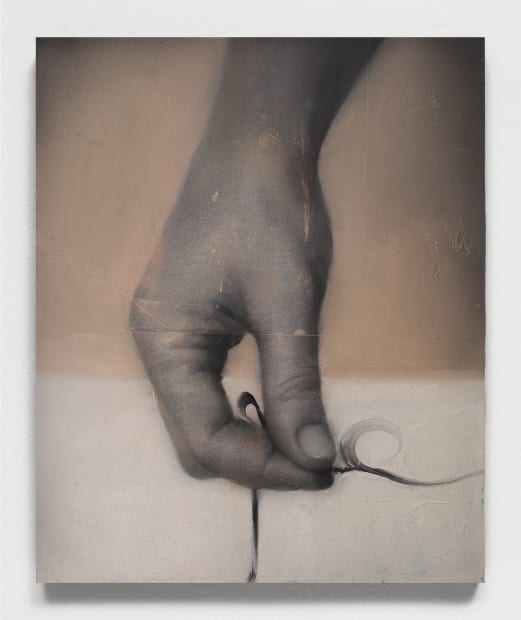
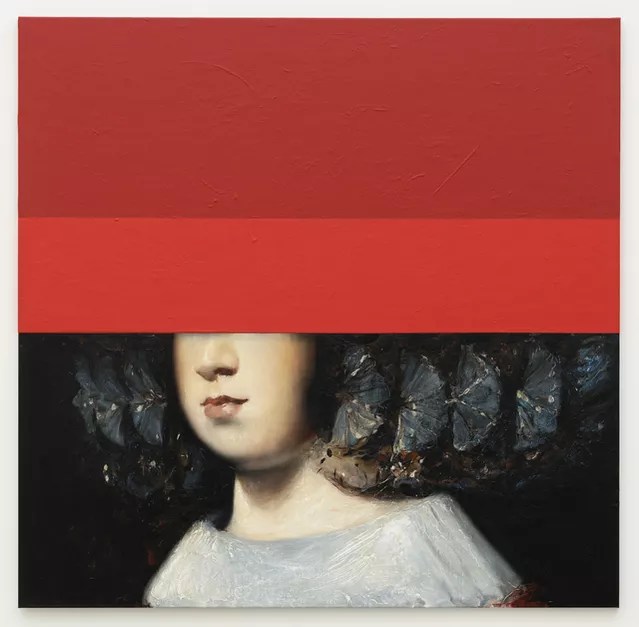
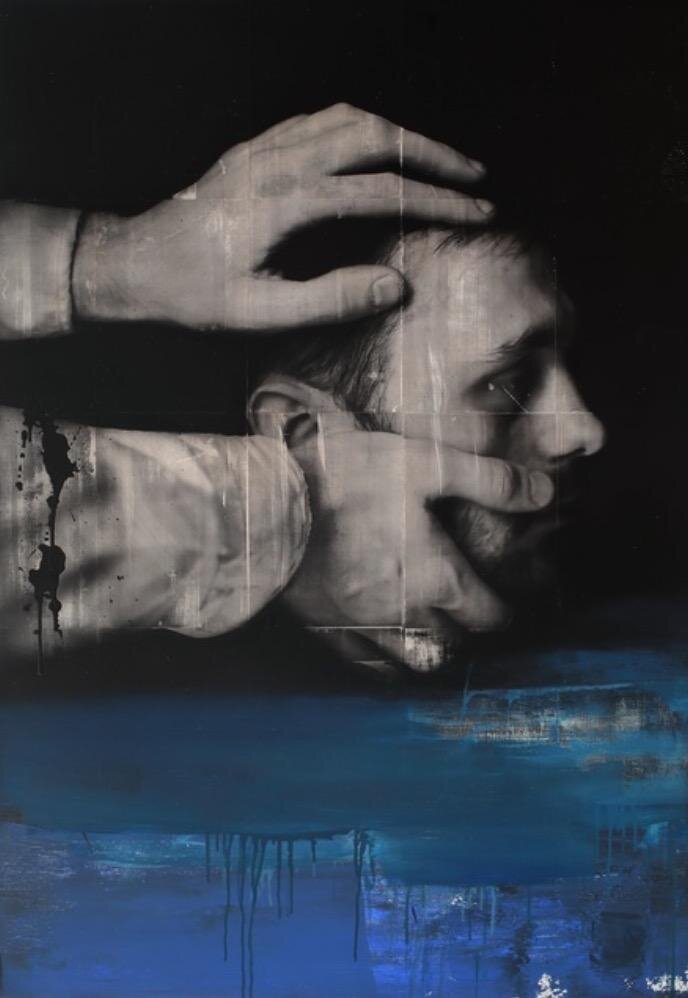
Born in Romania in 1978, Suciu works mostly in charcoal and oil. His remarkable paintings amalgamate excerpts from classical iconography (think Diego Velázquez or Maurice Utrillo for example) with geometric patterns in dark colours, to bring new meanings and to instill a deep sense of melancholia in the viewer’s eye.
These powerful works re-purpose existing visuals to consider ideas of experimentation, figuration and death. They also reflect the legacy of history and the socio-political background in which the artist developed as a child. Suciu grew up in a region of Romania affected by historical conflicts, contextualised by the 1989 revolution.
Imbued with nostalgia and spleen, Suciu often talks about the impact of reading the news every day, implying a sharp awareness of the tragedies of the world. But while his approach is rooted in representation and painting, the juxtapositions of images in his beautiful paintings, compare to the approach of a movie director. He quotes the dark worlds of David Lynch and the mysteries of Hitchock’s narratives as inspirations.
Suciu’s most significant exhibitions have included the 4th Prague Biennial, the 11th Istanbul Biennial, and the 16th Vilnius Painting Triennial and many more in the future for sure. His work can be found in the collections of the Fondation Francès Senlis in Paris and The Recent Art Museum in Bucharest.
Suciu talks to Art is Alive about his childhood, his main influences and his dreams.
How do you start your paintings: do you start with the subject matter, the content, or rather explore the techniques first? Do you draw first?
Art is a form of communication; I can’t start without knowing what I am about to say. I am searching for images that are related to my intention, I am producing images using my camera. it depends on what I am about to say. The technique is a tool, meant to represent best the idea, an idea, so the tool must be precise and fit for it. I love to experiment with all the techniques that are at my disposal.
I consider myself a self-thought artist although I graduated the fine art university. As a child I started reading about the life and work of the famous artists and I realized soon that I have to make copies of other painters in order to understand the process of art. Old school, but a healthy way to deeply learn the architecture of the image. After all I realized that there are infinite ways of representation. In the process of creation of an artwork there is always room for experiment. Although I want to have control of the technique, there is a constant struggle in building the image. That makes it challenging. I like to think that I am pushing the boundaries of the medium I am using.
Depending on the image I am making, I use pencil drawing, charcoal drawing, the airbrush, a simple paintbrush or I am using a monotype technique that I developed and overpaint on it, or I am using all of them. It doesn’t really matter. My goal is to achieve a strong image that gets to the viewer. I use all the tricks in order to arrive at an intense image.
Are you very prolific and quick or do you generally take your time to finish your works. What does that mean for the process?
It’s complicated, but I guess that I subscribe to the prolific profile. I like to work on several images at the same time. An image or an object needs rest, and my eyes need rest in order to understand what is going on. So, I like to sketch an image and let it “sit” for a while. The way I am working needs time, but I am a fast worker. The process gives me a natural high. For me, making art is also therapeutic. I am suffering from anxiety. I started doing/making art since I was 13. The death of my father was the trigger. Since then, I never stopped from creating. I need to see a new image daily in order to feel accomplished.
How do you see your paintings evolve? Will you continue to push the themes of your paintings?
Good question. I would like to answer to it firmly, but I think that I am carried away by the process itself. There are so many things to be explored, perfected. I want to evolve, and I realised quite soon that a painter that paints in a figurative manner will logically end up by doing abstract paintings. Time will tell. Anyway, the main trick is to work daily. The discipline of working, spending time in the studio gives all the answers. In the process of creation there is a constant battle with the matter, the substance that is building the image. That is how the image evolves, gets perfected.
There’s this inherent darkness and beauty in your work, can you talk a bit about this please?
When I started making copies of other artists, I started with Modigliani, Soutine, Utrillo, Lautrec, Ensor, Chagall, Nolde among others. I am in love with the Post Romantic/ Expressionist artists. There are so many artists that shaped my vision. I am on the dark side of the art. Cinema is a source of inspiration as well. Hitchcock and Lynch influenced my vision since I was younger.
The baroque art inspired me in placing the subject in this dark mood. Change is coming when things that we treasure are under threat. My work is mirroring the eternal uncertainty we are living under.
I like simplicity. I am building images that illustrate solitude. The object or figure represented is becoming symbolic and iconic at the same time.
For me, beauty is sublime. I believe art is dramatic and there is no other way of representing an image but in this perspective. For me art is serious and needs to be presented in a breathtaking light.
How much of your personal life do you draw into these works?
I started working/painting as a therapeutic way to cope with the loss of my father. I grew up during communism, my father used to travel abroad, he brought catalogues of all the great artists during a moment in which information was limited to almost nothing related to international culture. He helped me make my first drawings; I still remember how he helped me made a copy of Hokusai painting. I told you that for me art is therapy, but it was not recommended by a doctor, I just started working hours after his death, and I never stopped since.
I believe that art is extremely personal. There is no other way. I pay attention to all societial issues and reflect them in my own twisted manner. I look at politics, I watch and read the news from all over the world. And I am trying to reflect my thoughts and opinions in my art.
Your favourite artists, dead or alive? Inspiring cultural figures?
Tricky question. Like in music, the same in art. I love them all. I am a curious person. I wanted to learn about each important or less important figure in the art history. I mentioned some of them above. My tastes are extremely eclectic. I remember when I was in high school, I discovered the work of Paul Thek, I was amazed by the few images I managed to get my hands on. I recall my first encounter with Pollock, I was overwhelmed. Hartung made my days for a while, Baldessari and Rauschenberg are still on my hot list. I am going back and forth in art history to learn and be inspired. I look at Goya and Lichtenstein at the same time and I feel inspired by both.
There are so many, but the guy I am looking mostly at is Picasso. And not for the obvious reasons. I admire Picasso for the way he managed his creativity. For me, it is extremely important to learn how to cope with creativity, how to manage it in the proper way.
Recent book you read and loved?
To be honest I am reading less then I should. My daily reading consists of the news, artists’ statements, online art magazines. To save time, I listen to audio books, my recent and probably not a popular nowadays book is the Ilf and Petrov novels. The absurd humor and situations of the stories make me understand the politics of the old Union better.
What’s your dream project, museum exhibitions?
First, I need to be present and visible. A thing that is kind of complicated since we are living in the art industry moment. If there is something that is important regarding my work, then my work will be revealed and properly displayed. Like any other artist I dream of being displayed in all the great institutions, but I think that I will age like wine, and I will be present in the public eyes at the right moment.
Anyway, for my age I already did a few shows that are important. Some projects are ongoing and will be properly noticed.
How is format important? Are you interested in exploring other media?
I work with traditional media, I am into drawing, etching, painting, graphical techniques, photography. Lately I started welding and producing works in bronze. There is so much to explore and develop that I need a second life in order to finish some of my recent experiments.
Will we see an exhibition of your work in London soon?
I would love to have a venue in London, but I guess for the galleries in the UK I am an artist under the radar for the moment. The same goes for the institutions. I guess it’s not my time yet.
–

 ART IS ALIVE