The short video piece titled One Thousand and One Attempts to Be an Ocean (2021) by Chinese artist Yuyan Wang featured in the exhibition ‘Humaine Nature – Nature Humaine’ presented in Arles, in the South of France, was produced during the first covid 19 lockdown. This striking film compiles social media videos that were deemed ‘satisfying’ to watch and slightly addictive by viewers during this recent difficult time. The images mostly depict heavy machinery destroying mundane objects, repetitive mechanical processes, and large-scale industrial activities. According to the artist, this selection of visuals also connects to the ecological crisis. The work taps into human cognitive dissonance inherently rooted within the climate emergency. Rhythmically, it oscillates between accelerations and deceleration, another metaphor for market fluctuations.
This fascinating work perfectly summarises the conceptual framework behind ‘Human Nature’, the exhibition presented at Fondation Van Gogh until 10th April 2023 and curated by Bice Curiger, Julia Marchand and Margaux Bonopera. While Humanity is forced to rethink its relationship to nature, the exhibition offers artistic and poetic viewpoints to consider human behaviour towards the planet. It also suggests new considerations on the organic and the artificial.
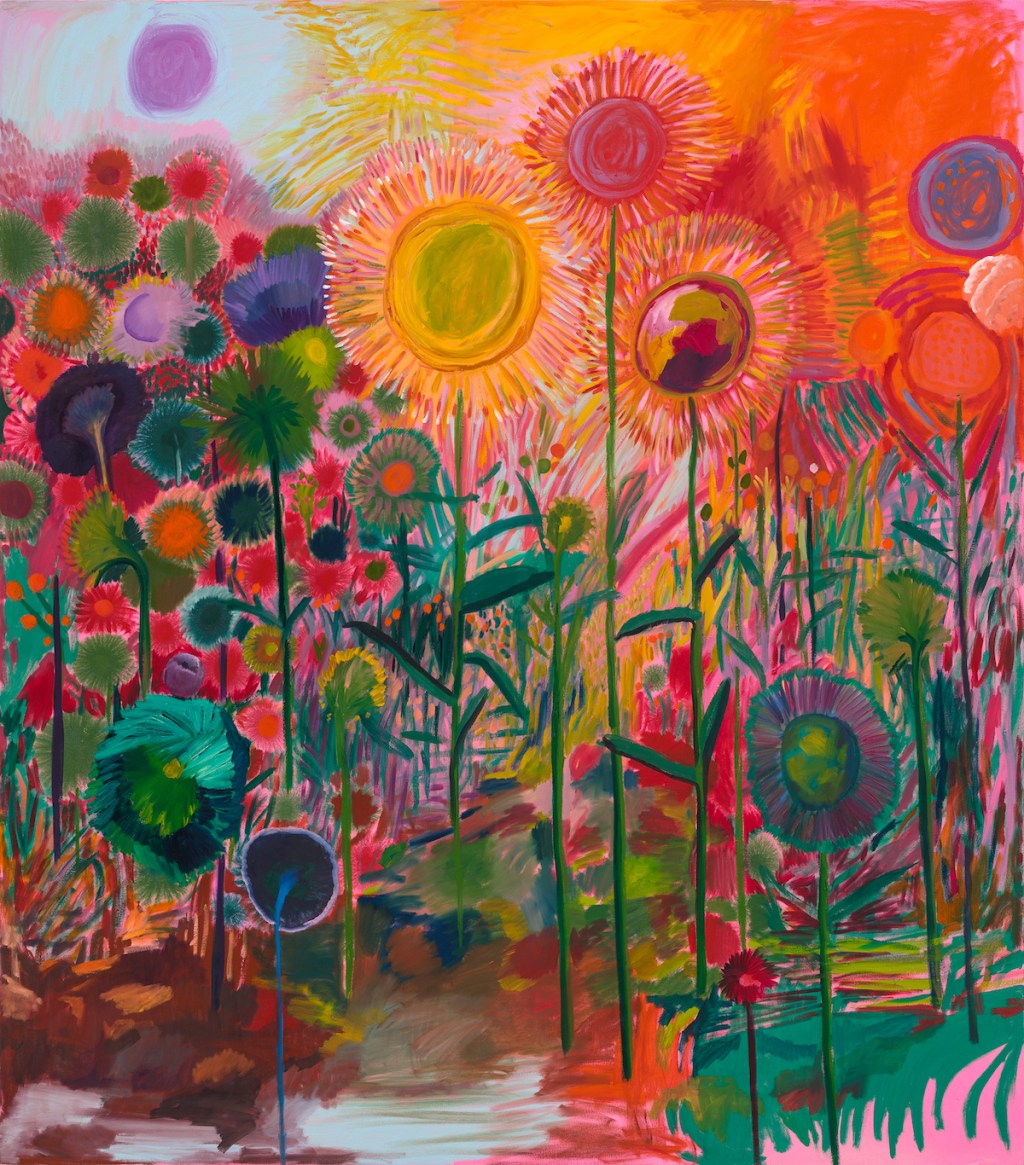
Central to the exhibition is a large room devoted to the vibrant paintings of Shara Hughes, an American artist from Atlanta. Hughes creates internal landscapes populated with various symbols, filled with fantastical vegetations and imagined perspectives reaching the psychedelic. By distorting the intrinsic qualities of plants, she challenges what viewers expect to see and feel. Natural elements are given strange textures reminiscent of plastic materials while fluorescent colours echo contemporary artificial digital images. The era of fake nature has started.
But how does the exhibition relate to the work of Van Gogh? The Dutch artist was a deep admirer of nature and throughout his short lifetime, he painted many landscapes in Provence, The Netherlands and around Paris, many natures mortes and trees. He often considered the significance of nature at a time when the world was going through the premises of mass industrialisation. Instead of blindly embracing it (he lived in Northern Europe and London for a while where the Industrial Revolution emerged), he chose to settle in the small town of Arles to paint olive trees and the Mediterranean sea in les Saintes Marie de la Mer. Illustrating Van Gogh’s perspective on humanity and nature, the exhibition features Trees, an oil on canvas painted in Paris in July 1887, on loan from the Van Gogh Museum of Amsterdam.
His interest in dense foliage and trunks is linked to his inspiration from painter Claude Monet. The Seine riverbanks painted by the Impressionist luminary was a great source of inspiration for Van Gogh, as testified in his letters to Australian painter John Peter Russell. During his stay in Paris, Van Gogh sought to capture the small areas of the countryside that resisted the industrial expansion of the French capital. This brought him to the South of France in 1888 where he continued exploring the vitality, strength, and power of vegetation he then so brilliantly depicted on canvas.
In the same elegant wooden-panelled room, a work by Rauschenberg resonates with Van Gogh’s glorious Trees. About this 1987 work, the American master said: “Vincent shows us a burst of colours in each of his paintings, I’ve always admired him; I was also thinking about his sadness and his solitude when I made this black sunflower with barbed wire with sunlit colors of the sunflowers.” If the sunflowers (his most iconic work) encapsulate Van Gogh’s vulnerability, it could also echo today’s melancholy and anxiety we may feel when faced with the climate crisis.
Fourteen artists are featured in this strong exhibition including Ed Atkins, Pamela Rosenkranz, Otobong Nkanga, and Gilles Aillaud, strikingly mixing modern and contemporary art. Their works evoke human domination over other aspects of life (animal life for example in Valentin Carron’s naïve opening sculptures). The sculptures, drawings or videos on view examine existential questions without dictating any moralistic ways forward.
The exhibition closes with Daniel Steegman Mangrané’s work, an artist from Barcelona but living today in Brazil, near the Amazon rainforest, a great source of inspiration to him. He questions hierarchies and authoritarian politics of opposing nature and culture. Titled Geometric Nature / Biology and made in 2022, the installation features a fragile beech tree branch entangled with metal cables. The piece perfectly embodies nature’s vulnerability and precarity humbling again viewers.
–

Images: Shara Hughes, Put On A Happy Face , 2021, 172.5 x 152.5 cm, Courtesy: the artist and Galerie Eva Presenhuber © Shara Hughes, Photo: Stan Narten, JSP Art Photography and Vincent van Gogh, Trees , Paris, July 1887, Oil on canvas, 46.5 x 38 cm, Van Gogh Museum, Amsterdam (Vincent van Gogh Foundation)
 ART IS ALIVE