
There’s simply no other place like Commanderie de Peyrassol. Located in the sunny South of France, at the crossroads between Brignoles, Saint-Tropez, and Le Muy, Commanderie de Peyrassol is a stunning property that combines heritage, excellent gastronomy, high-end hospitality, a remarkable permanent art collection and an amazing temporary exhibition programme. The marriage between disciplines is simply perfect. Peyrassol cements Provence as one of the new hubs for culture and contemporary art.
Starting with its impressive history, Commanderie de Peyrassol was founded in the 13th century by the Knights Templar. In 1204, the Order was given the estate by the Count of Provence, Alphonse II. “Peirason” became one of the many Templar’s “commanderies”, a safe space for prayers, military training, agriculture, tax collection and pilgrimage to the Holy Land. The property’s unique location and rich grounds made the monks start growing their cereals, olives, vegetables and of course grapes. Many centuries later, other significant historical events include the purchase of the land by the eminent Ricard family who bought Peyrassol in 1790 (the racecourse Paul Ricard isn’t far away today), a year after the Revolution.
Saint-Tropez being so close, it of course brings the 1960s spirit, the glamour and history of Provence to Peyrassol: think beautiful weather, French art de vivre, and fashion through Coco Chanel, who used to spend her summer on the nearby coast.
Before producing some of the best rosés that Provence has to offer today, archaeological traces date wine-making on the property back to the beginning of the Iron Age (1000 BC). The Gallo-Roman period also left even more remains on Peyrassol and original standing walls, from that time, still remain on the property. This fantastic history culminates with the production of wine, traced in 1256 in a parchment preserved in the Marseilles archives. The ideal location, nestled in the Massif des Maures, of the vineyard, sitting on clay and limestone soil, provides the perfect conditions for grape-growing.
Since the first wine varieties were planted by the Templars around 800 years ago, generations of wine growers have applied their know-how to nurturing the vineyard. Workers have cared for this exceptional terroir for centuries. “Across the group, we’re learning every day and adapting, especially about production and art curation. That’s an amazing journey for Peyrassol and a privilege to produce the best wines and feature fantastic exhibitions. Today, production is around 2 million bottles across 100 hectares”, General Manager Alban Cacaret explains about the strategy of the group and the inspiration for the property. Thirteen different grape varieties are present at Château Peyrassol. Red grape, used for rosé as well as for red wines, such as cinsault, grenache, tibouren, mourvèdre, syrah or cabernet-sauvignon. White grape varieties with rolle, ugni-blanc or sémillon for white wines, which can also be used for the production of rosés are also there. The richness of the soil is one of Peyrassol’s magical features.
Peyrassol’s rosé remains the biggest production of the domain. The white wines represent 5% of the estate’s wines, and they are made exclusively with Peyrassol’s blanc de blancs which provides refinement to the final product. The red wines are produced with the greatest precision. Guests will enjoy various tours, whether on cart, guided or alone, and tastings with specialists, as well as strolls through the impressive cellars, with oenology specialists and guides, are a must.
The experiential approach at Peyrassol is 360 degree. Alban Cacaret is quick to explain that the business and cultural approach follow long term plans. “One of our main initial goals was to restore the domain with views to generate organic growth as well as sharing our passion for both wine and culture. Marrying these different passions has been my uncle (Philippe Austry)’s motive as soon as he found the property. Getting together around art, and enjoying wine and gastronomy with artists, friends and family is what makes us human after all. Today, it also makes sense to share with wider audiences and gathering around this natural lanscape and art collection is rewarding.” he said.
Attention to details is everything for Peyrassol’s founders and one example is the design of the bottle inspired by the architecture of the Château’s main tower. It stands proudly at the centre of the property. Alongside the Templar’s cross which is featured on the bottles, the napkins, the signage and the menus of the fantastic restaurant “Chez Jeannette”.
This stunning restaurant offers seasonal cuisine prepared with the finest produce of Provence, served in a wonderful setting. The palette of the furniture and decor is gorgeous with mauve, brown and earthly colours resonating with the soil of of the region. The menu is simple, which doesn’t complicate choices, and makes choices always easy. Most importantly, gastronomy at Chez Jeannette is absolutely delicious. Each plate is beautifully presented by chefs Michel Portos (two stars at Guide Michelin) and Alexia Fresia. While Michel Portos was named “Cuisinier de l’année” in 2012 by the Gault Millau among other amazing positions, patissiere, Alexia Fresia also received various accolades. Restaurant Chez Jeanette, which boasts a remarkable terrace overlooking the Buren flags, is another reason to visit Peyrassol.
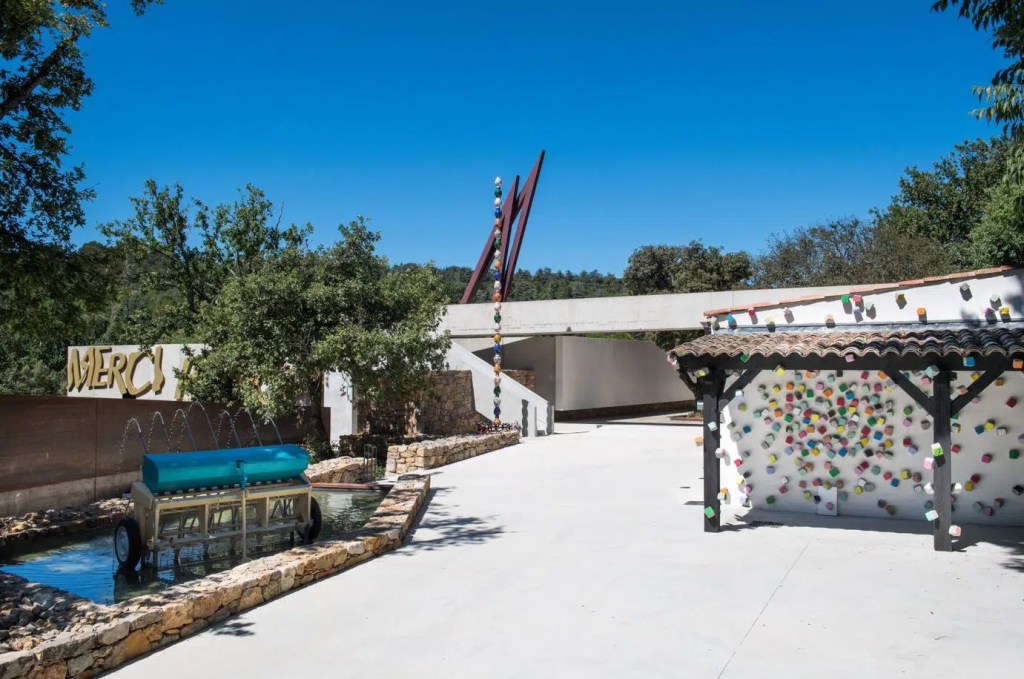
Art remains the main ambition for Peyrassol. On arrival and once passing the impressive steel-structure entrance lobby and shop, two large-scale Daniel Buren installations welcome visitors. The first one is the historical portico featuring Buren’s landmark colours. Throughout his very successful career Buren has created in-situ artworks that examine the relationship between art and the structures that frame it. The second amazing installation is a series of vibrant flags, which were mounted more recently and which have become one of the symbols of the property. The Commanderie de Peyrassol houses one of France’s largest private collections of contemporary art accessible to the public. Its garden is dotted with around 50 sculptures by luminaries, including Antony Gormley, Niki de Saint Phalle, Dan Graham, Carsten Höller, Bertrand Lavier, Richard Long, Ugo Rondinone, Lee Ufan, Victor Vasarely, Joana Vasconcelos ou encore, Bernar Venet. These are some of the biggest names in the modern and contemporary art world.
The open-air museum lives alongside Peyrassol’s owner (Philippe Austry)’s private collection, housed in various contemporary structures. Presented in the concrete and Corten steel designed-spaces by architect Charles Berthier, a recent 800 m2 hosts solid exhibitions curated by Galleria Continua and in-house curator Mathilde Marchand. Disseminated across the exhibition space, visitors can find major works including Tengan-Tenganan (2009) by Frank Stella, Triple X Neonly (2012) by François Morellet, La Sirène (1983) by Niki de Saint Phalle, Model of the Tower aux figures (1986) by Jean Dubuffet, Le Mobile (2005) by Xavier Veilhan, Incomplete Open Cube (1973) by Sol LeWitt, Relief Télélumière (1982) by Takis, Table Piece CCL (1975) by Anthony Caro.
Peyrassol was recently extended to welcome brilliant exhibitions which mix the collection with loans from around the world. Most recently, and on view until 1st November is La mise à nu de la société, a brilliant new show by one of the leading figures of Italian art, Michelangelo Pistoletto.
Running alongside this impressive exhibition, is Face au temps, which brings together contemporary works from the Philippe Austruy Collection with an exceptional selection of twenty paintings ranging from the 15th to the 17th centuries, part of the De Jonckheere collection. This exhibition is an evocation of the human experience through time exploring parallels, affinities and contrast between contemporary visions and classical paintings. “What we have tried to stage by bringing together the works from our collections is not a confrontation, just a didactic presentation of works collected with high standards and passion.” Georges De Jonckheere and Philippe Austruy explain about the concept of the show.
Through a great selection of very important artists, the exhibition explores historical visions and pictorial sensibilities on light and darkness, knowledge and freedom. Works by artists including Etel Adan, Anthony Caro, DeWain Valentine, Xavier Veilhan, Chiharu Shiota (who represented Japan at the Venice Biennale in 2015), Yoan Capore, François Morellet are brillantly juxtaposed with masterpieces by Pieter Brueghel the young, Aert Van Den Bossche, Hieronymus Francken, Lucas Cranach and more significant names in art history.
Highlights of the property of course include the stunning sculptures by Bernar Venet presented across the gardens. The artist collaborated with Philippe Austry to design a unique bench made of his signature steel in the stunning garden of the living areas. Bernar Venet (b.1941, Château-Arnoux, France), is a French conceptual artist best known for his sculptures in steel that appear to defy gravity. As a young boy, Venet moved to Nice to work as a set designer for Opéra de Nice. During the 1960s, Venet developed his Tar paintings, Relief cartons and his iconic ‘Tas de charbon’ (Pile of Coal), (1963), his first sculpture with no specific shape. In 1966, Venet moved to New York, where, over the next five decades, he explored painting, poetry, film and performance. Today, Venet’s work can be found in more than 70 museums worldwide, including The Museum of Modern Art (MoMA), New York; the Solomon R. Guggenheim Museum, New York; the Hirshhorn Museum and Sculpture Garden, Washington D.C.; and the Centre Pompidou, Paris among other prestigious museums. Peyrassol displays many of his works, some large-scale, others more intimate, and they perfectly merge with the trees, plants and organic world of Peyrassol. The relationship to nature is very important for Peyrassol’s direction.
Commanderie de Peyrassol features among the Vignobles Austruy portfolio and following the acquisition of the Provençal estate, other properties around Europe have joined the family. Château Malescasse in Bordeaux, Quinta Da Côrte in the Douro and Tenuta Casenuove in Tuscany all managed by Alban Cacaret.
Leading excellence in art, gastronomy, wine and art de vivre, Commanderie de Peyrassol has it all, exceptional exhibitions and public art installations, astonishing wines, sensational nature and really-nice, dedicated and knowledgeable staff. Stay tuned for the incredible rotating exhibition programme and make sure to spend time in this wonderful property, the epitome of France’s taste, aesthetics and a sense of details in all its forms.
–





 ART IS ALIVE