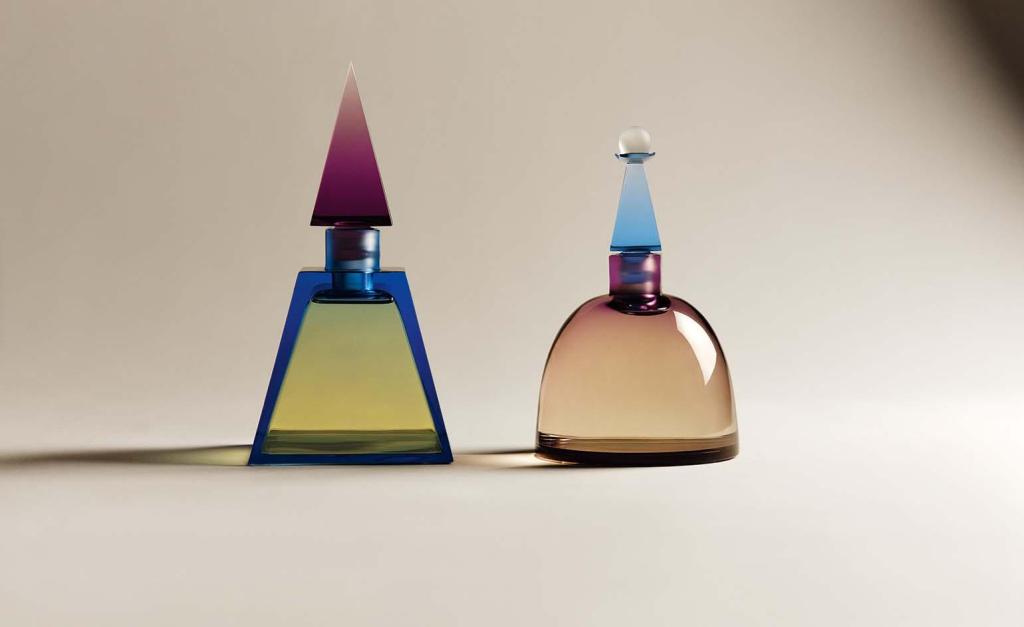
American light and space master James Turrell, and glassmaker Lalique join forces on a collection of crystal light panels and perfumes which exclusively debuted this week at Paris+ Art Basel (taking over FIAC).
Founded over a century ago, in 1888, Lalique has endured as the ultimate symbol of French luxury. Lalique continues to thrive as a truly timeless lifestyle brand.
James Turrell has dedicated his practice to what he has deemed perceptual art, investigating the materiality of light. Influenced by the notion of pure feeling in pictorial art, Turrell’s earliest work focused on the dialectic between constructing light and painting with light, building on the sensorial experience of space, colour, and perception. ‘We are quite unaware of the power of light. I would like to make light such that it is an inspiration to things beyond, beyond what we think we know, The nature of my work is the shaping of light. Light is the material; perception is the medium. There is no image in my work because I am not interested in representation,” he mentions in the exhibition catalogue.
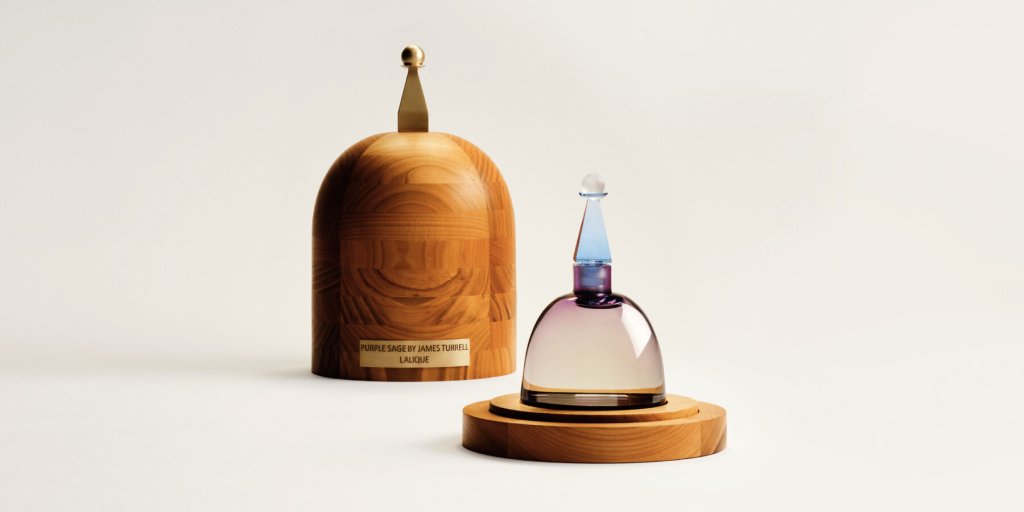
Turrell worked with Lalique to create stunning new Crystal Light Panels, an anthology of photographic works that showcase 30 different colour sequences made to trigger a sensorial reaction, and Ranger Rider and Purple Sage, two exclusive fragrances, inspired by desert ranges and light horizons, and the Great American West depicted by Zane Gray in his novel, Riders of the Purple Sage.
“I created these two fragrances, Range Rider and Purple Sage, to capture the scents of my country. A concentration of skies, horizons and light. Range Rider captures and releases the substantial fragrances of my land: those of animal, sage-scratched leather chaps, pepper, amber and citrus. An olfactory architecture that speaks of the sun-drenched Western ranching. Purple Sage, named after this delicate, queen of plants that blooms exclusively in Arizona, offers a different interpretation of my relationship with the great American West, undulating between delicacy and strength. This is the first time I have designed perfumes and made crystal pieces. Creating a perfume is a bit like creating a world you have known.“
The Crystal Light series for Lalique captivates viewers changing colours. Turrell has used light directly instead of reflecting it on the surface. Turrell’s first one-person exhibition, James Turrell: Light Projections, was held in the fall of 1967 at the Pasadena Art Museum. Curated by John Coplans, an accompanying catalogue essay was also published in the October 1967 issue of Artforum. This seminal exhibition positioned Turrell at the forefront of the Light and Space movement.
The artist set out to create artworks and architectural sites in which the sun and the moon are brought into intimate spaces.
“In this light panel, specially created for Lalique, the color sequences trigger vibrations. As in my other works, this ripple effect is intended to draw the viewer into an intimacy that is both open and closed, offering a paradigm of life. First of all, light is a substance. It is important to know this because we have no physical perception of it, except on our skin in the form of vitamin D. However, it also has a spiritual dimension, which can be found not only in the Bible but also in Buddhism, Hinduism, and Islam. We also speak of light in the near-death experience, the light at the end of the tunnel, a vision bathed in celestial light.“
 ART IS ALIVE