
Over the Maures massif, in the heart of Provence, close to Saint Tropez and Ramatuelle, La Commanderie de Peyrassol estate is one of the most remarkable properties of the South of France.
Peyrassol features incredible grounds, an exceptional restaurant, a beautiful adjacent guest-house cottage, all spanning centuries of history. First and foremost one of France’s most significant wine-making properties, Peyrassol‘s wines are exquisite. They come in three colours, red, white and rosé, and faithfully reflect the domaine’s 13th century tradition of wine-making. The wines are crisp, elegant and infused with the true spirit of Provence.
In addition, the modern and contemporary art collection disseminated throughout the property is key when experiencing Peyrassol. Currently on view until 1st November is Michelangelo Pistoletto’s show La mise à nu de la société housed in Peyrassol’s permanent exhibition space.
Michelangelo Pistoletto (b. 1933, Biella, Italy) is widely recognised as one of the most influential contemporary artists of his generation and a leading proponent of Arte Povera. Since the 1960s his work has developed a body of conceptual sculpture situated within this Italy-born movement, in parallel to an ongoing series of Mirror Paintings, comprising figurative, graphic or sculptural images applied to the surface of polished stainless steel. Representing his dual interest in Conceptualism and Figuration, together these two bodies of work have brought Pistoletto to the forefront of the art world.
Alongside this practice, Pistoletto is the founder of the Cittadellarte in Biella, an interdisciplinary laboratory that nurtures social change through artistic practices. Its DNA is centred around The Third Paradise, conceived in 2003 as the promise of a future realm in which nature and society can coexist in harmony.
Peyrassol’s brilliant exhibition, conceived in partnership with Galleria Continua, brings together recent works by Pistoletto, from the “Messanudo” (naked) series initiated in the summer of 2019 and finalised in the winter of 2020, during the peak of Covid-19.
Examining today’s society where every man considers selfish interests to the detriment of collective concerns, Pistoletto stages naked people in the literal sense of the term, bringing humanity to its purest and most Humanist form.
The mirrored surface is instrumental to Pistoletto’s practice. The reflective plane of his paintings draws the viewer and their environment into the work, altering the fiction of the painted image as a frozen moment. An advocate of the performative in art, Pistoletto’s work emphasises dialogues, spontaneity, the possibilities of imagination in his work. The mirror creates a gateway into the virtual space of the work, creating a portal between art and life, between the work and the viewer. ‘The true protagonist’, he wrote of his mirror paintings in 1966, ‘was the relationship of instantaneous-ness that was created between the spectator, his own reflection, and the painted figure, in an ever-present movement that concentrated the past and the figure in itself to such an extent as to cause one to call their very existence into doubt: it was the dimension of time itself’.
Continuing his famous series at Peyrassol and the ability to reflect the upheavals of the world, the artist serigraphs the naked bodies of people, of different skin colours and ages, on large mirrors installed close to the ground. Rid of their artifices, no social class or border separates them. They hug, touch, kiss, laugh, love each other, respect each other, pay attention to each other. Beauty and kindness guide their gestures here by revealing the distance that sometimes interferes between our daily relationships.
Pistoletto’s impressive Quadri specchianti explore our relationship to the body and place nudity and innocence on the same level, here by activating ideas of equality. These stunning works arranged the white cube of Peyrassol smartly redefine the human condition.
To make these important works, Pistoletto produced a sheet of stainless steel polished to a mirror finish, onto which he applied an image made by tracing a photograph blown up to life size on flimsy paper. In 1971 he started to replace the painted paper with a silkscreen process in which the original photograph was transferred directly onto the sheet of reflective steel, and by 1973 this had become the definitive technique.
The Mirror Paintings quickly brought Pistoletto international recognition and success. In 1964 he took part in a series of major European exhibitions devoted to New Figuration, Pop Art and New Realism. Over the course of the sixties, he was also invited to hold solo exhibitions at important galleries and museums in Europe and the United States: in 1964 in Paris (Galerie Ileana Sonnabend); in 1966 in Minneapolis (Walker Art Center); in 1967 in Brussels (Palais des Beaux-Arts), New York (Kornblee Gallery), Cologne (Galerie Zwirner), Detroit (J.L. Hudson Gallery) and Paris (Galerie Ileana Sonnabend); in 1969 in New York (Kornblee Gallery), Rotterdam (Museum Boymans van Beuningen) and Buffalo (Albright Knox Art Gallery).
These Pistoletto works have many different temporal and narrative planes. A piece that constantly changes bringing new perspectives on humanity and exist through multiplicity of reflections.
It’s a real chance to see the latest incarnation of these works at the stunning Commanderie Peyrassol and the exhibition shouldn’t be missed.
–
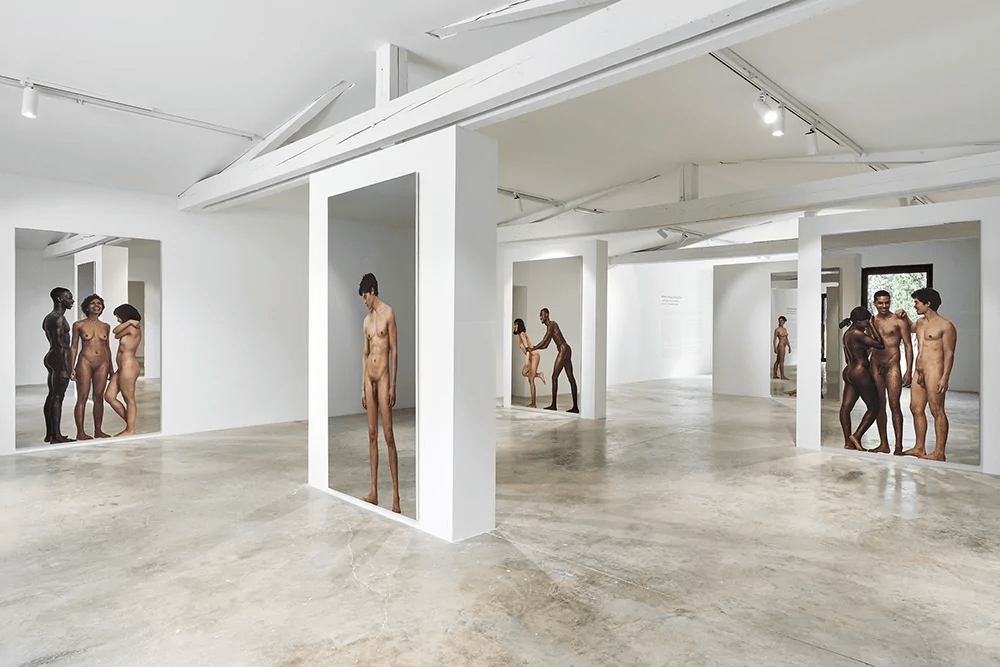


Images: Michelangelo Pistoletto – Venere degli stracci 1967 – 2022. ‘La mise à nu de la société’. Exhibition view. Photo: Jeanchristophe Lett and Michelangelo Pistoletto – La mise à nu de la société. Exhibition view. Photo: Jeanchristophe Lett
 ART IS ALIVE